MDF wood is widely used for office desks, cabinet doors and wall panels because its flat surface is easy to machine. Businesses should select the appropriate MDF core and surface finish for each application, considering the conditions of use, cleaning requirements and maintenance.
1. What is MDF wood?
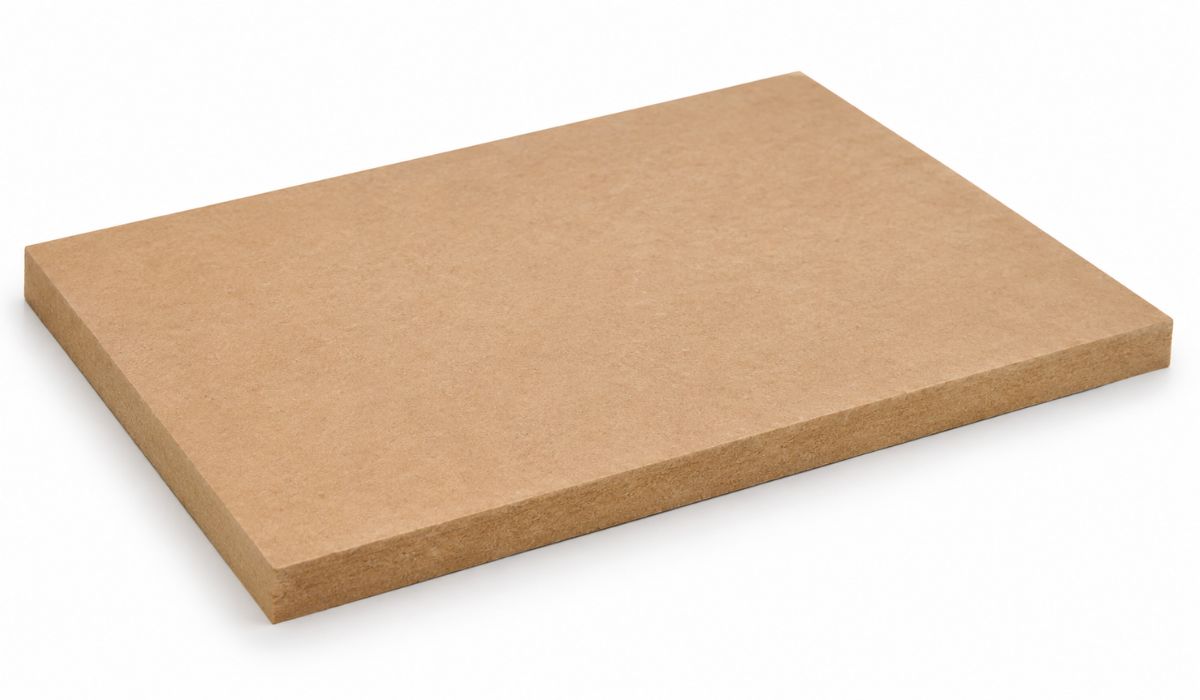
MDF (medium-density fiberboard) is a type of engineered wood made by hot-pressing a mixture of wood fibers and adhesive. Its relatively uniform fiber structure produces a flat surface suitable for cutting, routing, painting or applying decorative finishes.
2. Composition of MDF boards
An MDF core consists of wood fibers mixed with adhesive and a small quantity of additives. The proportions vary depending on the board grade and intended application.
- Wood fibers: These make up most of the board. Wood chips are broken down into fine fibers that can be distributed evenly before pressing.
- Adhesive: The adhesive cures during hot pressing, bonding the fibers into a board. Standard MDF commonly uses urea-formaldehyde (UF) adhesive.
- Additives: Paraffin wax helps reduce moisture absorption. Depending on the board grade, other additives may be included to meet specific application requirements.
3. MDF board manufacturing process
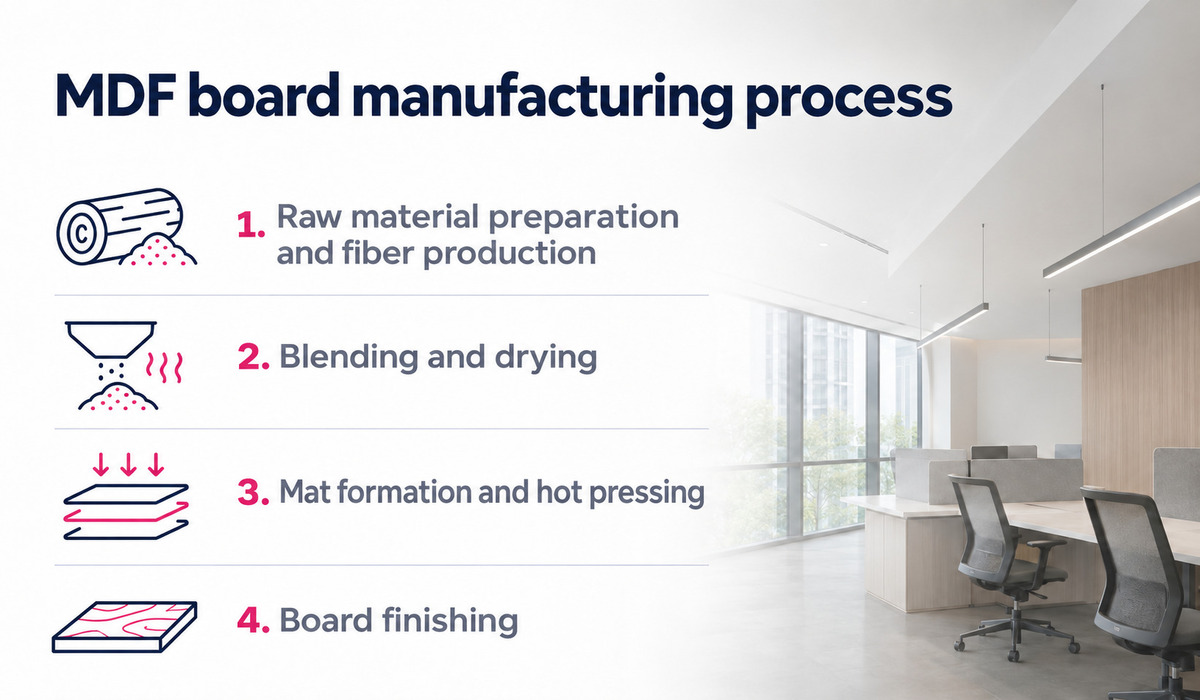
In the dry manufacturing process, wood chips are broken down into fibers, mixed with adhesive and dried before board formation. Fiber moisture content and distribution are controlled to achieve consistent board thickness and density after pressing.
| Step | Description |
|---|---|
| 1. Raw material preparation and fiber production | The wood is cleaned, chipped and softened with steam. The chips pass through a refiner that separates them into fibers. |
| 2. Blending and drying | The wood fibers are mixed with adhesive and additives according to the formulation for each board grade. The mixture is dried to a suitable moisture content before mat formation. |
| 3. Mat formation and hot pressing | The fibers are distributed evenly and pre-pressed to form a stable mat. During hot pressing, pressure compresses the fiber mat to the required thickness, while heat cures the adhesive and bonds the fibers into a board. |
| 4. Board finishing | The boards are cooled, cut to specified dimensions and sanded on both sides to achieve the required flatness and thickness. Finished boards are inspected before surface finishing or packaging. |
4. Common types of MDF wood for office interiors
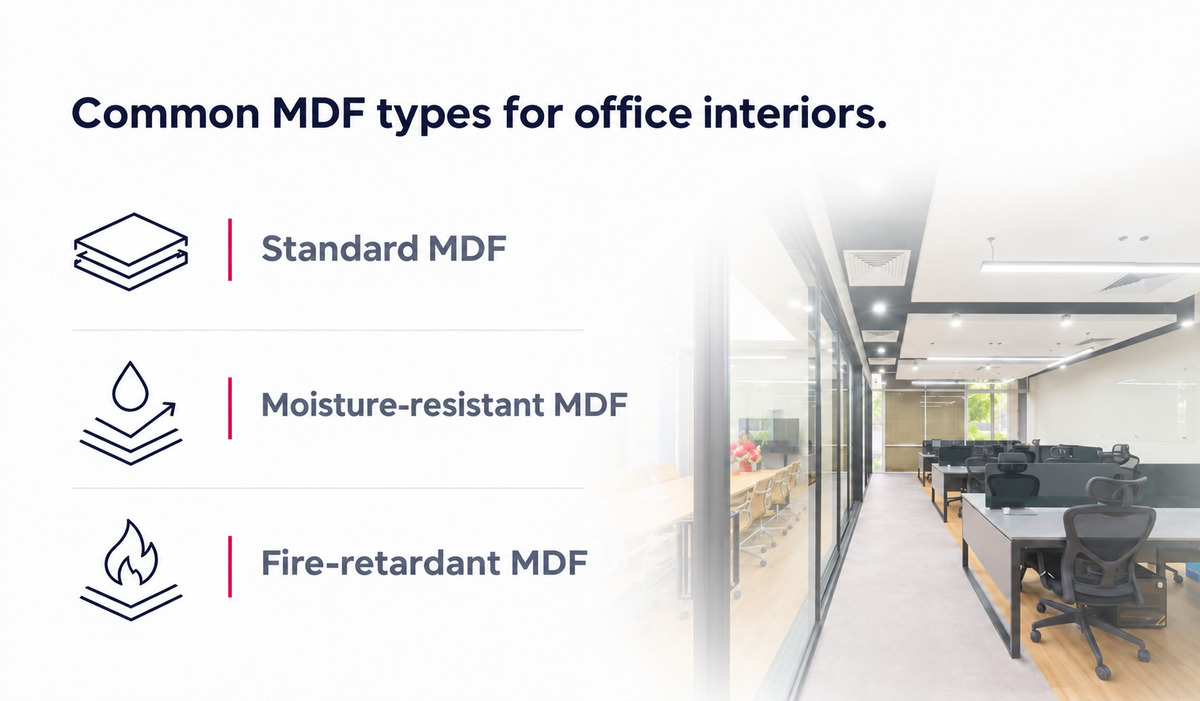
MDF wood comes in several grades suited to different office conditions. Desks commonly use standard MDF, while pantry cabinets near water sources require moisture-resistant boards. For applications with fire safety requirements, businesses should check the board’s properties and applicable regulations before selecting a product.
4.1. Standard MDF
Standard MDF has a flat surface and is easy to cut, drill and route. It is commonly used for desks, filing cabinet doors and decorative panels in dry areas. Depending on the design, the surface can be painted or finished with melamine, laminate or veneer.
For cabinets positioned against walls or close to the floor, check for dampness in the wall and whether the cabinet base may come into contact with water during floor cleaning. Water entering through cut edges or drilled holes can cause the MDF core to swell, affecting durability and joint integrity.
4.2. Moisture-resistant MDF
Moisture-resistant MDF uses an adhesive system or additives that help limit swelling when exposed to moisture. It is suitable for pantry cabinet doors and furniture near beverage preparation areas, subject to each product’s conditions of use. A green core is commonly used to identify moisture-resistant MDF, but the product code and technical specifications should be checked to confirm its actual moisture resistance.
In areas exposed to splashing, cut edges, drilled holes and exposed core sections must be sealed. For locations with frequent standing water or a risk of leaks, businesses should consider office furniture materials with more suitable water resistance.
4.3. Fire-retardant MDF
Fire-retardant MDF contains components that improve its reaction-to-fire performance compared with standard MDF. It may be used for certain decorative cladding applications with fire safety requirements, depending on the product’s technical classification and installation conditions. When selecting a board, check its thickness, the supporting substrate and the installation method for compatibility with the design documentation.
For doors or partitions with a required fire-resistance rating, using fire-retardant MDF alone does not establish compliance. Businesses need to review the technical documentation for the complete assembly, including material layers, framing and connections, against the office’s fire prevention and protection requirements.
5. Advantages and disadvantages of MDF wood
MDF wood has a flat surface, is easy to machine and is widely used in office furniture manufacturing. However, when used for desktops, shelves or load-bearing components, board thickness, loads and installation methods require careful consideration to ensure durability.
5.1. Advantages of MDF wood
Its uniform wood fiber structure makes MDF easy to machine into different shapes and suitable for various surface finishing methods. Key advantages include:
- Easy machining: Boards can be cut, drilled and routed to match drawings, making it convenient to manufacture multiple components with identical dimensions.
- Suitable for painting: The flat, smooth surface supports an even paint finish once the board faces, cut edges and routed grooves have been properly prepared.
- Varied surface finishes: Melamine, laminate and veneer offer a selection of colors and woodgrain patterns to suit the design.
5.2. Disadvantages of MDF wood
Alongside its machining and aesthetic advantages, MDF has several limitations, particularly in wet areas or components subject to heavy loads.
- Swelling when water penetrates: Water entering through cut edges, drilled holes or joints can cause the board to swell and compromise connections.
- Potential sagging under load: Long desktops and shelves require suitable board thickness and support spacing for the intended load.
- Edge damage from incorrect screw installation: Suitable screws and pilot holes are needed to reduce splitting and crumbling at board edges.
6. Surface finishes for MDF wood
MDF wood can be painted to achieve the colors specified in the design and is particularly suitable for cabinet doors, rounded edges and routed details. Before painting, board faces and edges must be sanded smooth, cleaned and primed. Cut edges generally absorb more paint and require careful preparation to achieve consistent color and sheen.
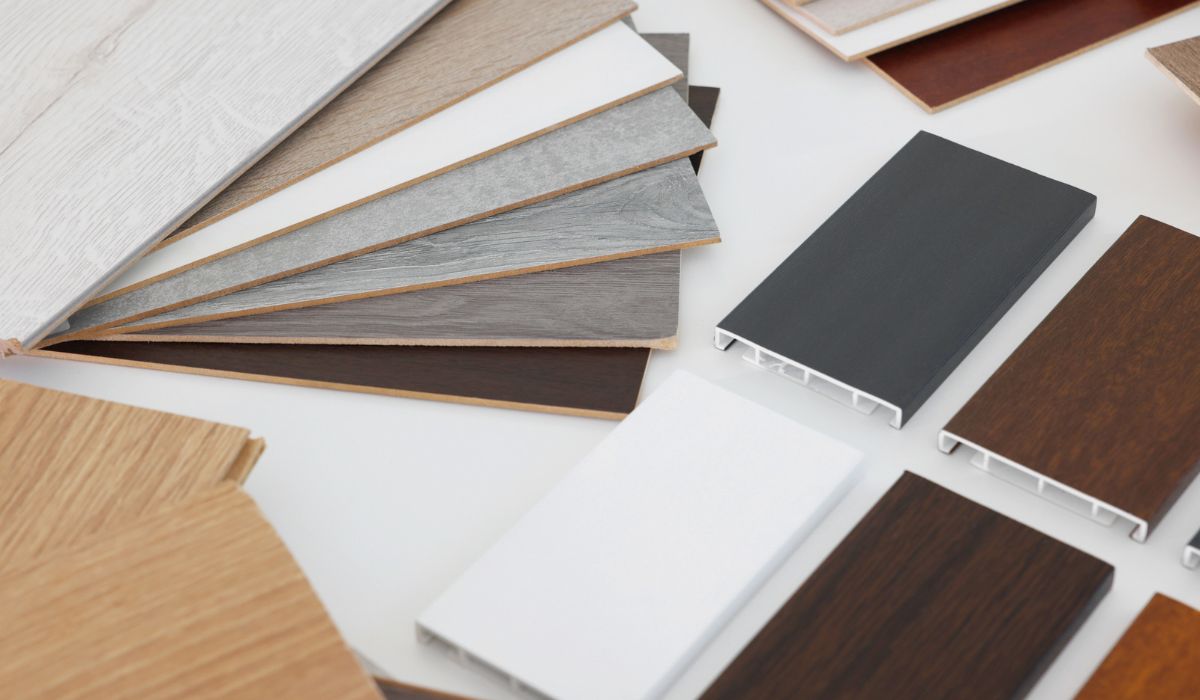
MDF can also be finished with decorative materials in various colors and woodgrain patterns. For desks or cabinet doors with exposed edges, select surface finishes and edge banding with compatible colors and sheen. Businesses should inspect an edge-banded sample before production to assess workmanship and consistency between the board faces and edges.
7. Four common surface coverings for MDF boards
MDF wood can be combined with different surface coverings to achieve the colors, woodgrain patterns and sheen required by the interior design. Melamine, laminate, acrylic and veneer are four common choices for offices. Each has different characteristics in terms of appearance, durability and ease of cleaning.
7.1. Melamine-faced MDF
Melamine-faced MDF comes in various colors and woodgrain patterns and is commonly used for filing cabinet doors, desk screens and other office furniture components. The surface is easy to wipe clean and suitable for everyday use. Where adjacent panels have a woodgrain finish, the grain direction should be coordinated for a consistent appearance.
7.2. Laminate-faced MDF
Laminate consists of multiple layers pressed together and offers various colors, patterns and surface properties. Laminate-faced MDF is commonly used for desks, reception counters and other frequently used surfaces. When selecting a product, check its scratch and abrasion resistance, along with the treatment of board edges, particularly around cable access holes.
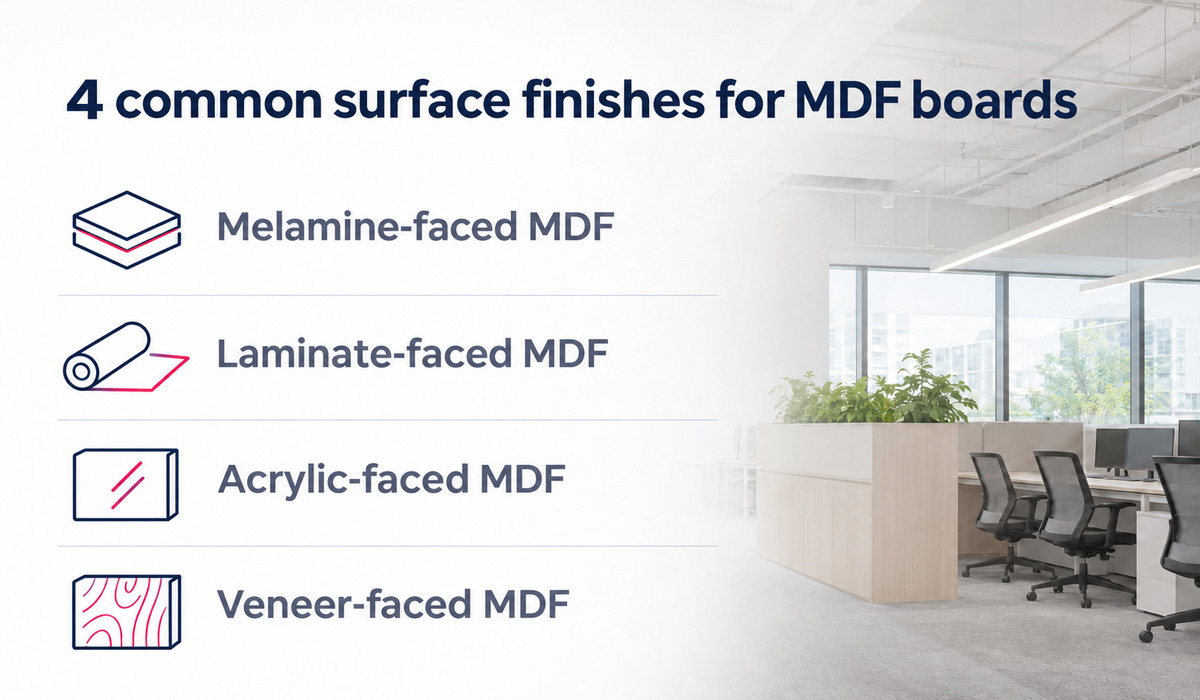
7.3. Acrylic-faced MDF
Acrylic-faced MDF features a high-gloss surface that reflects light and gives interiors a modern appearance. It is commonly used for cabinet doors, decorative panels and furniture details intended as visual features. When reviewing samples, assess the gloss and reflections under the office’s actual lighting conditions, and consider the visibility of scratches and fingerprints.
7.4. Veneer-faced MDF
Veneer-faced MDF uses a thin layer of natural wood bonded to the board core, retaining the distinctive color and grain of real wood. It is commonly used for meeting room wall panels, reception counters, cabinet doors and furniture details that call for a natural wood appearance. When installing adjacent panels, select and arrange the grain direction to create a coordinated overall finish.
8. Applications of MDF wood in office interiors
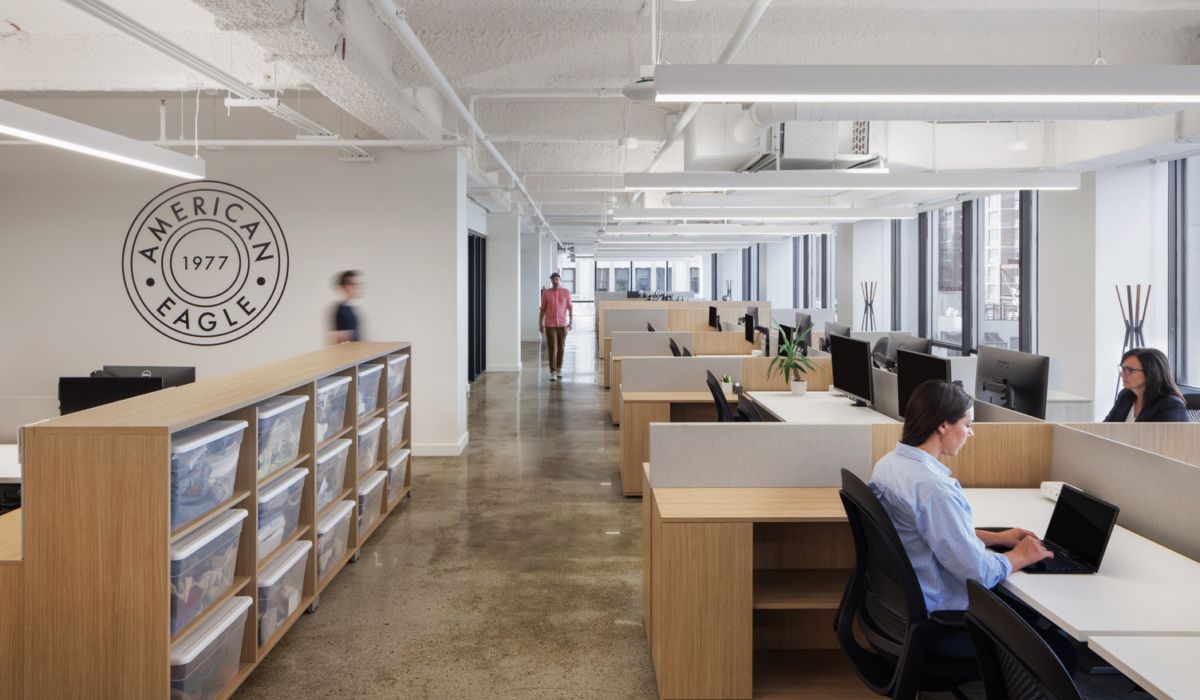
MDF wood is commonly used for desks, filing cabinets, decorative wall panels and pantry cabinets. In office interior design and construction, each application has specific requirements for durability, load-bearing capacity and moisture resistance. Businesses can use the following table to select suitable MDF for each location.
| Application | Conditions of use | Suitable MDF type | Selection considerations |
|---|---|---|---|
| Desks | Dry areas with frequent use | Standard MDF with a melamine or laminate finish | Check desktop thickness, support spacing, desk edges and cable access holes. |
| Filing cabinets and shelving | Loads from files and stored items | Standard MDF with a thickness appropriate for the load | Check the strength of shelves, hinges and screw fixing points. |
| Decorative wall panels | Primarily decorative, potentially comprising multiple panels | Painted MDF or MDF with decorative finishes as specified in the design | Check flatness, joints, grain direction and any fire safety requirements. |
| Pantry cabinets | Areas with high humidity or potential water splashes | Moisture-resistant MDF in locations with limited direct water contact | Seal board edges and drilled holes, and inspect areas near water pipes. |
>> Read more: Common types of wood used in office design
9. Criteria for assessing MDF wood quality
Before approving MDF wood samples, businesses should review the core specifications, surface quality and formaldehyde emission documentation. This information must match the design requirements and selected materials to ensure quality during manufacturing and installation.
9.1. Core product code, board dimensions and thickness
Check the product code, MDF grade, board dimensions and thickness against the supplier’s technical documentation. For desktops, shelves and cabinet doors, the actual thickness must match the design drawings to meet functional and installation requirements.
9.2. Surfaces, board edges and hardware
MDF surfaces should have consistent color, sheen and grain patterns that match the approved design sample. Edge banding must be flush, fully bonded and free from peeling. For cabinet doors or components with hinges and screw connections, inspect a trial assembly to assess strength and opening and closing performance.
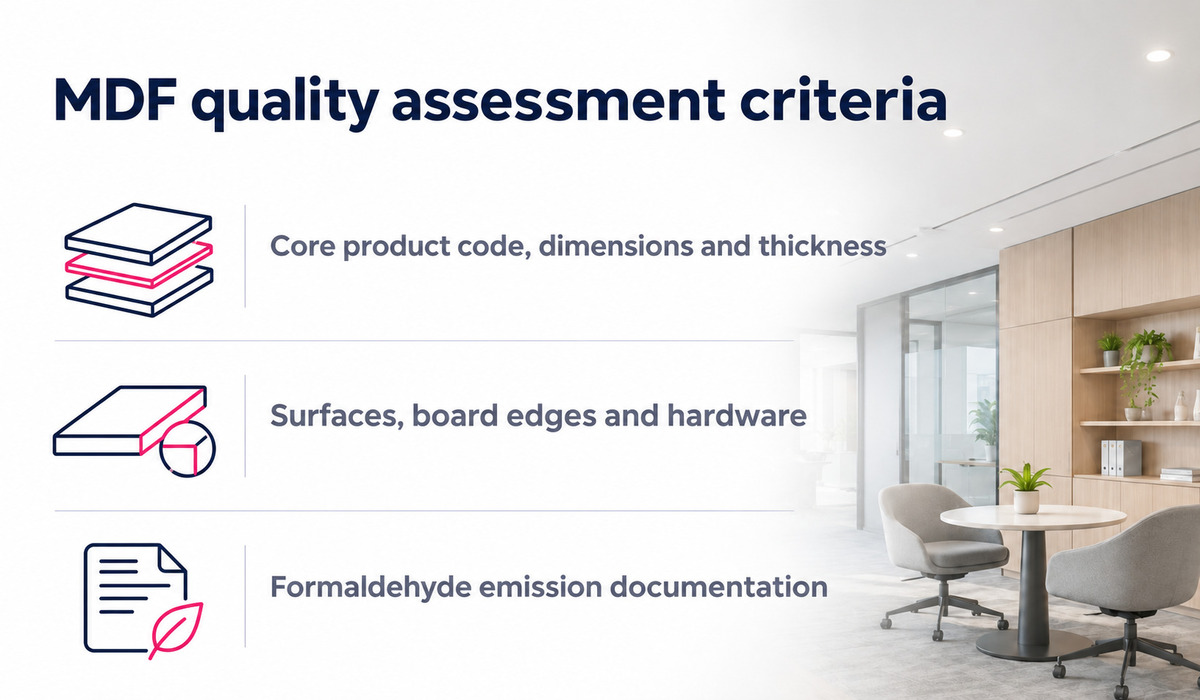
9.3. Formaldehyde emission documentation
When selecting MDF, businesses should review formaldehyde emission documentation for the exact board grade they intend to use. If the product is declared as E0, E1 or E2, check the applicable standard, test method and units used to report emissions. Also establish whether the documentation covers the MDF core or the board with its surface finish.
When selecting MDF wood for an office, businesses should start with how each item of furniture will be used. An everyday desktop and a cabinet near a sink have different core and finish requirements. Before placing an order, inspect a sample with finished faces and edges, then record the approved board and surface finish codes in the documentation for checking upon delivery.
10. Frequently asked questions (FAQ)
10.1. Is MDF wood durable?
MDF can provide long service when the board core suits the moisture conditions and loads of the application. A frequently used filing cabinet needs adequately supported shelves and correctly installed hinges. During cleaning, wipe away standing water from edges and joints to reduce the risk of water entering the core.
10.2. Can moisture-resistant MDF be used for an under-sink cabinet?
Moisture-resistant MDF may be considered if the cabinet interior remains dry during normal use and can be easily inspected for leaks. Cut edges, pipe penetrations and exposed core sections must be sealed. If standing water occurs frequently or pipework is difficult to access for inspection, consider a material better suited to water exposure.
10.3. What documentation is needed to check formaldehyde emissions from MDF boards?
Ask the supplier for a test report or certificate that covers the intended board product code. When reviewing the report, check the results, test method, units, test date and issuing organization. If the project requires an assessment of the finished board, review documentation for the exact finished product.
10.4. What is the difference between MDF wood and MFC?
MDF is made from wood fibers. MFC is melamine-faced particleboard. MDF is an option to consider when components require routing followed by painting. For flat panels with a melamine finish, businesses can compare MFC, MDF and HDF based on the conditions of use, machining requirements and budget.