Hybrid working combines office-based work with work from remote locations. Businesses can set fixed or flexible office attendance schedules based on job requirements and collaboration needs. Understanding the different formats, benefits, and conditions for adoption helps businesses choose an approach that suits their employees and office space.
1. What is hybrid working?
Hybrid working combines working in the office with working remotely. Depending on job requirements and collaboration needs, businesses can set fixed or flexible office attendance schedules. Working hours are determined by each business’s policies.
2. Common hybrid working formats
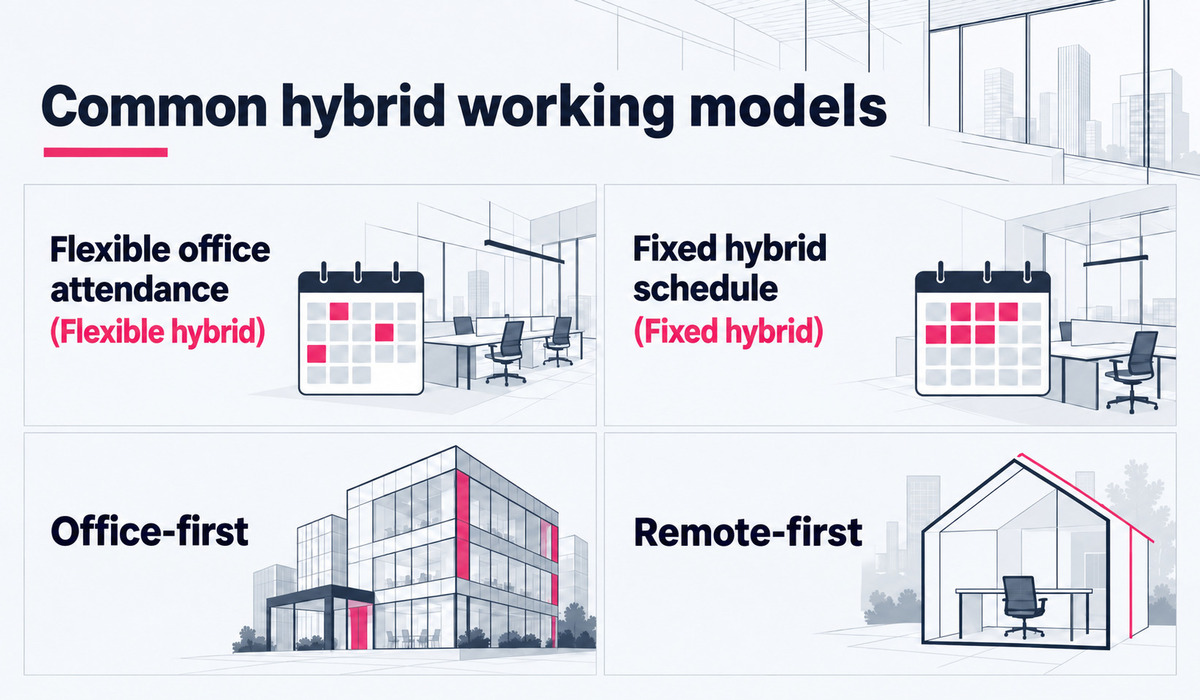
Four common hybrid working formats are flexible office attendance, fixed hybrid schedules, office-first, and remote-first. They differ in how office attendance is scheduled, how much remote work is prioritized, and how teams are expected to collaborate.
2.1. Flexible hybrid
With a flexible hybrid arrangement, employees choose whether to work in the office or remotely based on their tasks, meeting schedules, and personal needs. Their schedules must align with the business’s overall policies.
Businesses can designate days when employees need to meet in person to discuss work and coordinate. Flexible hybrid working is often suited to roles that can be performed independently and assessed by their results.
2.2. Fixed hybrid
With a fixed hybrid schedule, the business sets in advance which days employees work in the office and which days they work remotely. The schedule may apply company-wide or be arranged separately for each team.

For example, a team might work in the office three days a week and from home two days a week. This is an example schedule, not a universal standard. A fixed schedule helps businesses estimate how many people will be in the office each day so they can plan seating and meetings.
2.3. Office-first
An office-first arrangement makes the office the primary workplace. Employees may still work remotely on agreed days when their work allows. Activities that require in-person discussion, on-site equipment, or coordination among several people are usually carried out in the office.
Businesses may choose this format for teams that need to meet in person frequently or perform tasks that are difficult to complete remotely. Its suitability should be assessed based on the responsibilities of each role, rather than applied uniformly across an entire industry.
2.4. Remote-first
A remote-first arrangement makes remote work the primary format. Employees communicate, share documents, and coordinate work through online tools. Teams can still meet in person at the office for meetings, project discussions, or group activities.

Businesses adopting a remote-first format typically define communication channels, response times, and how shared information is recorded. These practices help employees track work and coordinate across locations.
3. Hybrid Working in Vietnam
During and after the COVID-19 pandemic, many businesses alternated remote work with days in the office. Hybrid working has been considered as a way to maintain activities that require in-person collaboration while giving employees more flexibility in where they work.

CBRE’s 2026 Vietnam office-space survey found that the multinational companies surveyed were interested in collaboration, employee experience, flexibility, and space costs, alongside workforce size. The results reflect only the surveyed group. When adopting hybrid working, businesses still need to consider job requirements, HR policies, and operational conditions.
4. Benefits of the hybrid work model
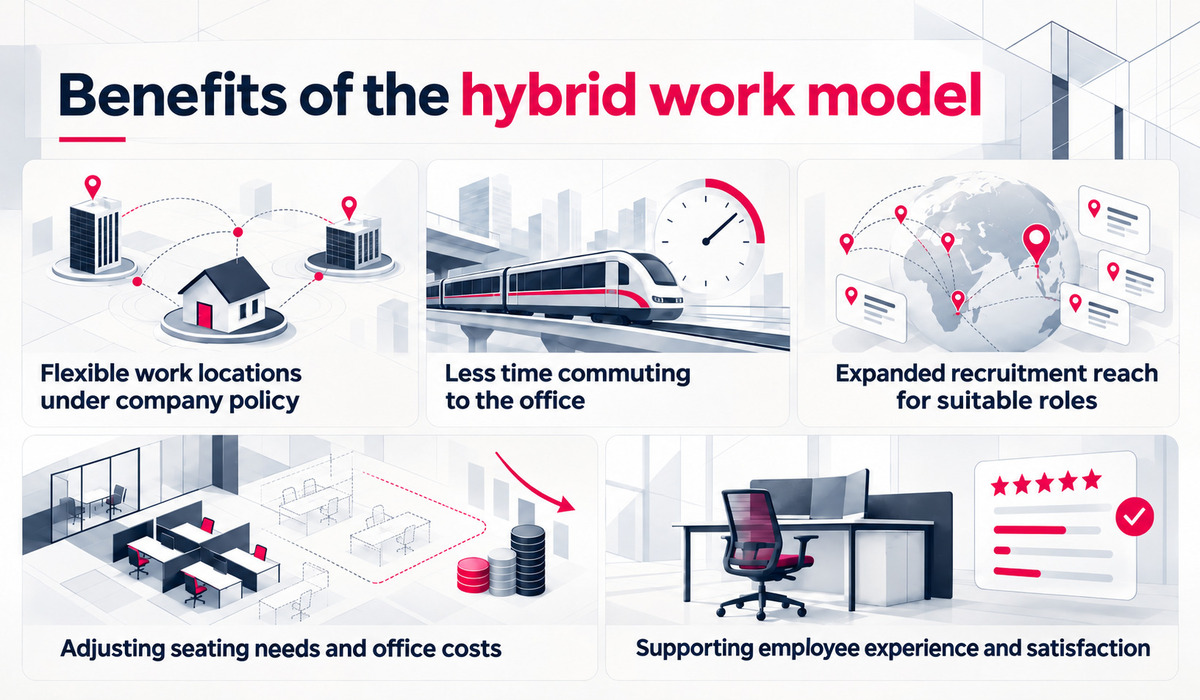
Hybrid working can give employees more flexibility over where they work and reduce commuting time. For businesses, it expands recruitment options and creates an opportunity to reassess office-space needs. The cost and employee-experience benefits depend on office attendance schedules and how work is organized.
4.1. Flexible work locations under company policy
Employees can work in the office, at home, or elsewhere, subject to company policy. This flexibility lets them choose an environment that suits the task, whether it requires focus, discussion, or consideration of personal circumstances.
Office attendance schedules still need to be coordinated to support collaboration across teams. For example, employees may work independently from home but need to be present when their team meets in person. Working hours are determined separately according to the applicable agreement and policies.
4.2. Less time spent commuting to the office
Working remotely on some days helps employees reduce commuting time and costs. They can use the time saved for personal activities, family care, or rest.
The ability to balance work and personal life also depends on workload and time management. If employees regularly work outside normal hours or lack a suitable workspace at home, the benefits of reduced commuting may be limited.
4.3. A wider recruitment reach for suitable roles
Hybrid working can help businesses expand their candidate search when a role does not require daily office attendance. It suits positions that can be performed remotely and coordinated online, particularly those involving mostly computer-based work.

Recruitment reach still depends on how often employees need to be in the office, commuting distance, and company policy. Roles that require frequent in-person attendance must still meet workplace-location requirements. Hybrid working can expand the candidate pool, but it does not remove geographic limits entirely.
4.4. Adjusting seating needs and office costs
When employees come to the office on different days, businesses can consider reducing the number of assigned desks or arranging shared seating by schedule. Space requirements also vary according to work, meeting, and collaboration activities.
To determine whether space and costs can be adjusted, businesses should consider:
- Attendance levels: Estimate the number of people in the office on the busiest day and during peak hours, rather than relying on an average.
- Space requirements: Review the need for desks, meeting rooms, pantries, focus areas, and support spaces.
- Costs and contracts: Check whether the leased area can be adjusted, along with lease terms and the costs of changing the layout.

The number of employees working remotely does not directly translate into the percentage of office space that can be reduced. If the leased area stays the same, the main benefits come from reorganizing seating, space, and operations rather than immediately reducing rent.
4.5. Supporting employee experience and satisfaction
Flexible work locations and less commuting can give employees greater autonomy, help them manage personal time, and improve their work experience. When policies are clear and reflect actual needs, employees may also find it easier to stay engaged with the business.
Employee satisfaction, retention, and performance depend on how the model is organized, workload, and remote working conditions. Businesses should track employee feedback, work results, and staff turnover to assess its actual effectiveness.
>> See also: What Is Workplace Experience? Factors That Determine Employee Retention
5. Challenges of adopting hybrid working
Hybrid working can make it more difficult for businesses to schedule office attendance, coordinate teams, share information, and assess work results. Working across multiple locations also creates technology and data security requirements. The impact depends on the nature of the work and how the business operates.
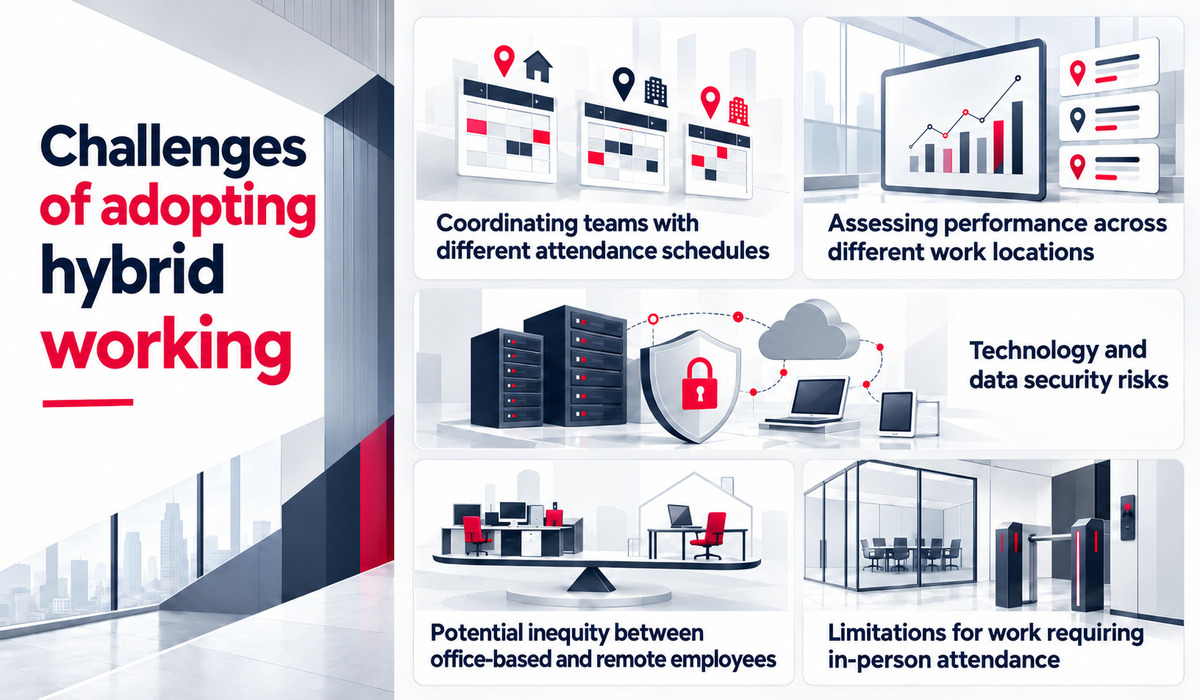
5.1. Coordinating teams with different attendance schedules
When employees come to the office on different days, scheduling in-person discussions can be difficult. Project teams may have to wait until all members are available before discussing issues and agreeing on solutions.
Coordination between departments can also be disrupted if information is mainly shared in person at the office. Remote employees may not receive timely updates about decisions or changes that affect their work.
5.2. Assessing performance across different work locations
Time spent in the office does not fully reflect work progress or quality. When employees work across multiple locations, managers need performance criteria that suit the responsibilities of each role.

If goals, responsibilities, and progress-tracking methods have not been agreed upon, assessments may rely too heavily on office attendance or a manager’s subjective judgment. This can make evaluations inconsistent and may not accurately reflect employee contributions.
5.3. Technology and data security risks
When working remotely, employees may need to access company documents and systems from multiple locations. Unstable connections, device issues, or unsuitable access permissions can interrupt work and affect data security.
The level of risk depends on the type of data and how employees access systems. Businesses should review their existing technology infrastructure, control access permissions, and guide employees on protecting information relevant to their work.
5.4. Potential inequity between office-based and remote employees
Employees who come to the office regularly may have more opportunities to speak directly with managers. If evaluations are based mainly on attendance, businesses may fail to recognize the contributions of remote employees fully, affecting their development opportunities.

The risk of inequity depends on how work is assigned and assessed. Clear responsibilities and consistent evaluation criteria help reduce differences in how results and development opportunities are recognized across employee groups.
5.5. Limitations for work requiring in-person attendance
Roles involving machinery, on-site equipment, direct client service, or production activities often require employees to be present at the workplace. Tasks that can be completed online usually offer more flexibility in work location.
Within the same business, administrative, sales, technical, and operations teams may have different office attendance needs. Before setting a hybrid working policy, businesses should assess each role and its responsibilities instead of applying the same schedule to all employees.
6. Conditions to consider when adopting hybrid working
Before adopting hybrid working, businesses need to assess job requirements, attendance schedules, and collaboration needs. A suitable policy helps employees understand their responsibilities and gives the business a consistent basis for organizing operations.
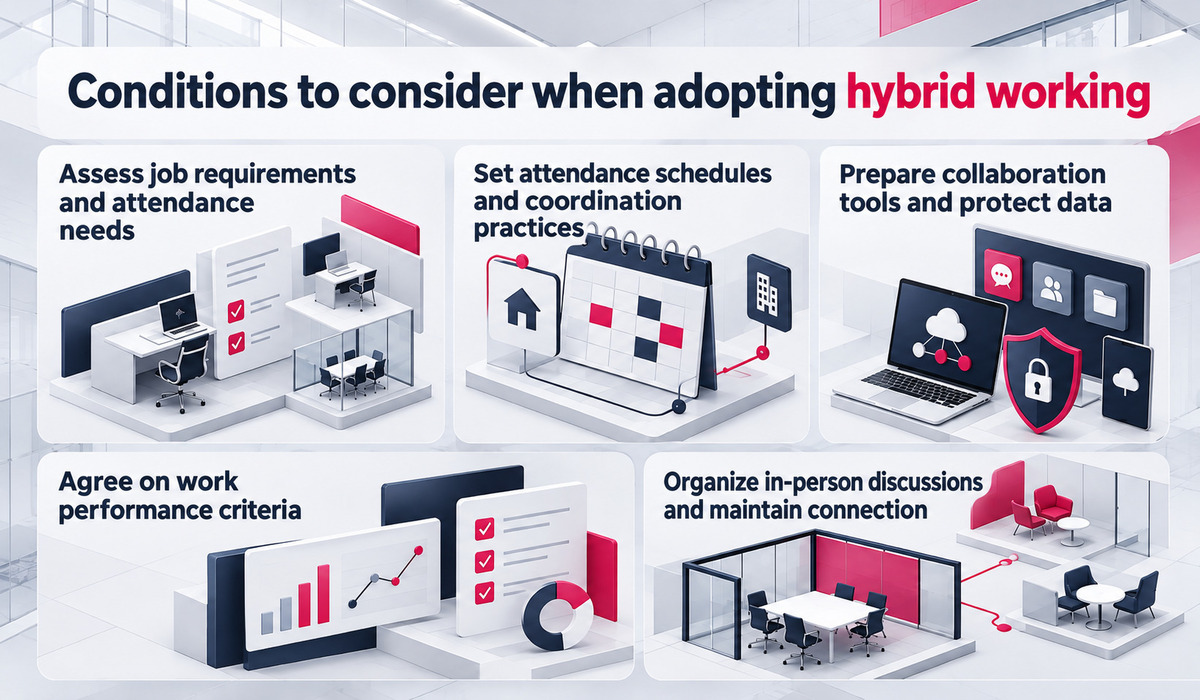
6.1. Assessing job requirements and attendance needs
Businesses should survey employee needs and identify tasks that can be performed remotely. The assessment should distinguish between independent work, activities that require in-person collaboration, and tasks that require equipment at the office.
Input from each department helps businesses determine appropriate attendance levels. For example, a team that regularly holds project meetings may need shared in-office days, while employees doing independent work may have more flexibility over their location.
6.2. Setting attendance schedules and coordination practices
A hybrid working policy should define who it applies to, how many days employees work in the office, how schedules are arranged, and when attendance days can be changed. Businesses should also agree on communication hours, meeting practices, and responsibilities for sharing updates.

Clear rules help teams coordinate proactively and reduce differences in how the policy is applied. When developing the policy, businesses should consider agreed working conditions and requirements specific to each role.
6.3. Preparing collaboration tools and data protection
Hybrid teams need suitable ways to communicate, share documents, and track work. Businesses may use video-conferencing software, project management systems, or their existing storage platforms.
Before investing in new tools, businesses should review whether their existing systems meet their needs. Employees need to know how to use the tools, store documents in the correct locations, and access data according to their permissions. Specific security requirements depend on the information being handled.
6.4. Agreeing on work-performance criteria
Businesses should define goals, deliverables, and deadlines for each role. Performance criteria should reflect the nature of the work rather than rely solely on the amount of time employees are in the office.
Managers can track progress through work reports and agreed check-ins. When criteria are applied consistently, both office-based and remote employees have a clear basis for understanding expectations and discussing results.
6.5. Organizing in-person discussions and maintaining connection
Businesses can schedule shared in-office days for tasks that require discussion, training, or coordination across departments. In-person schedules should be based on work needs so employees can use their office time effectively.
Alongside in-person meetings, businesses need to maintain online communication channels and a shared system for storing information. Recording decisions after meetings helps remote employees follow work and take part fully in team activities.

To adopt a hybrid working model, businesses need to identify which tasks require in-person work and set office attendance schedules for each team. When seating, meeting-room, or support-space needs change, businesses should survey the workplace before adjusting the layout. Survey data provides a basis for planning office design and construction that suits actual operations.
7. Frequently asked questions about hybrid working (FAQ)
7.1. How is hybrid working different from working from home (WFH)?
Work from home (WFH) means employees perform their work at home, either full time or on some days of the week. Hybrid working combines office-based and remote work, and working from home can be one part of the model.
7.2. How is hybrid working different from remote working?
Remote working means working outside the business’s office, either full time or for part of the workweek. Hybrid working combines remote days with days in the office. The specific work locations are determined by the agreement and policies in place at the business.
7.3. What spaces does an office using hybrid working need?
An office using hybrid working may need flexible seating, meeting rooms equipped for online meetings, focus areas, group discussion areas, and a pantry. The number and arrangement of each type of space depend on office attendance schedules, the number of employees present on the busiest day, and each team’s needs.
7.4. Which businesses are suited to hybrid working?
Hybrid working suits businesses with roles that can be performed partly remotely but still require in-person collaboration. Businesses can set hybrid schedules for individual departments based on job responsibilities, the ability to collaborate online, and office attendance requirements.
7.5. Can hybrid working reduce costs?
Hybrid working can reduce costs when a business can adjust its leased area or operating expenses to match space usage. If the leased area stays the same, the main benefit is more efficient use of space. Before assessing potential savings, businesses should also account for technology, desk management, and layout adjustment costs.