
Company departments handle functions such as human resources, finance, sales, and production. Each department has its own responsibilities and works with relevant teams. Depending on its industry and size, a business may establish separate departments or combine several functions within one team.
1. What are company departments?
A department is a unit within a company’s organizational structure responsible for an assigned group of tasks. Its scope is defined by its duties, authority, manager, and working relationships with other units. The names and number of departments depend on the workload and management needs of the business.
2. Company departments and their main functions
In a company’s organizational structure, the executive team oversees operations, while departments handle specialized functions. Work may be divided across production, human resources, finance, sales, and operational support. Depending on the company’s size and structure, one department may handle several functions.
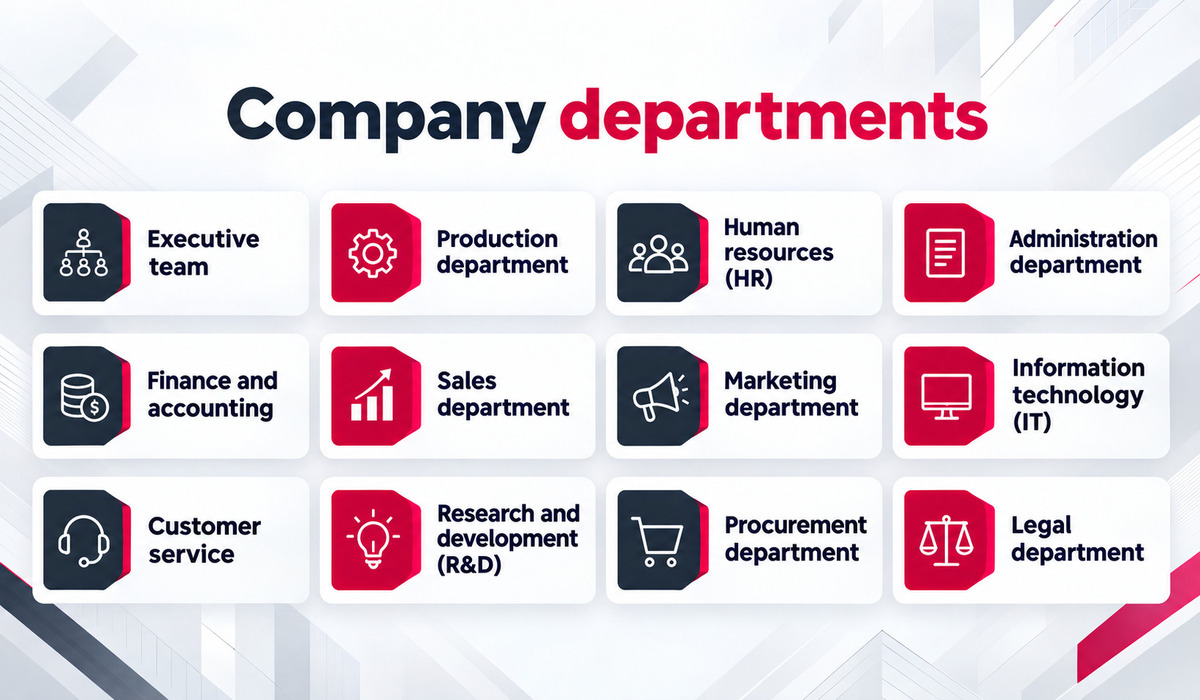
2.1. Executive team
A company may use the term “executive team” for the group responsible for leading and managing its operations. Depending on the organizational structure, this group may include the Director, General Director, and managers responsible for specific business areas. Its membership and authority are determined by the company type, charter, and delegation of responsibilities.
The executive team implements strategies, business plans, and decisions approved by the relevant authority. It coordinates work across departments, monitors results, and addresses issues within its assigned remit. Decisions on investments, company restructuring, or significant transactions must comply with the applicable authority requirements.
2.2. Production department
The production department organizes and oversees the process of manufacturing products according to plan. This function is common in manufacturing, processing, and assembly businesses. Its main responsibilities include production planning, workforce allocation, progress monitoring, and quality control during operations.

The department also monitors equipment, raw material usage, and opportunities to improve processes. When production needs change, it works with procurement, warehousing, and other relevant teams to adjust plans. Depending on the company’s structure, supporting functions may be organized as separate departments.
2.3. Human resources department (HR)
The HR department is responsible for recruiting, managing, and developing the company’s workforce. It identifies hiring needs, sources candidates, supports employee onboarding, and manages employee information as assigned.
HR also helps develop compensation policies, organize training, evaluate employees, and monitor workforce changes. Work involving insurance, employee records, and labor relations must comply with current regulations. The company and the individuals legally responsible must still fulfill their respective obligations.

2.4. Administration department
The administration department supports the office’s day-to-day operations. Its work is typically divided into several areas:
- Correspondence and records: Manage documents, maintain administrative records, prepare materials, and receive information.
- Assets and supplies: Track stationery, shared assets, and equipment.
- Facilities support: Coordinate cleaning, maintenance, reception, and other services that support office operations.
Some companies combine administration and HR in one department. When adopting an Administration–Human Resources model, the company should clearly assign responsibility for each group of tasks.
2.5. Finance and accounting department
The finance and accounting department manages capital and cash flow, records transactions, and provides financial information to the company. The two functions are commonly assigned as follows:
- Finance: Prepare budgets, determine capital requirements, and manage cash flow.
- Accounting: Record economic transactions, manage supporting documents, track receivables and payables, and prepare reports as required.

The department may also track fixed assets, reconcile figures, and prepare documents for tax obligations. Under the Law on Accounting and related regulations, a company may assign accounting work to an employee or hire an accounting service provider, provided the applicable legal requirements are met. Each person’s and department’s responsibilities depend on regulations and the company’s actual delegation of duties.
2.6. Sales department
The sales department sells products, provides services, and develops customer relationships. It identifies prospective customers, receives inquiries, advises customers on products, and prepares sales proposals in line with company policies.
The department may negotiate transaction terms, coordinate contract preparation, and track revenue. Contracts made on behalf of the company must be signed by an authorized representative. Sales also works with marketing to receive leads and with customer service to support customers after a sale.
2.7. Marketing department
The marketing department researches market needs, organizes marketing activities, and develops the company’s brand image. Depending on the business model, it analyzes target customers, develops communications plans, and runs advertising through selected channels.

Marketing also manages communications content, monitors campaign results, and maintains relationships with media partners. It works with sales to reach customers and share market information. Marketing research should be distinguished from the product research and development work carried out by R&D.
2.8. Information technology department (IT)
The IT department manages and supports the technology systems used in business operations. Its scope commonly includes computers, software, networks, user accounts, and technology equipment. IT also helps employees resolve technical issues and monitors system performance.
The department implements data protection measures in line with company policies and works with system users to identify support needs. Depending on its internal capabilities, a company may assign IT to develop software or manage specialized systems, or use external technology services.

2.9. Customer service department
The customer service department receives and handles support requests from customers using the company’s products or services. It provides information, answers questions, gives usage guidance, and records feedback through the company’s contact channels.
When a complaint or issue requires specialized handling, customer service works with the responsible departments to determine how to resolve it. The department also consolidates feedback, tracks the status of cases, and maintains customer contact in line with company service policies.
2.10. Research and development department (R&D)
The research and development department conducts research, testing, and development of products, technologies, or processes. Depending on the industry, it may develop new products, improve existing ones, or study how to apply technology in manufacturing and service delivery.

R&D develops research plans, organizes tests, evaluates results, and proposes technical improvements. It works with marketing to understand market needs and with production to assess feasibility. Work involving the registration or management of intellectual property rights should be coordinated with the legal department or another designated specialist.
2.11. Procurement department
The procurement department arranges the purchase of goods, raw materials, and services needed for production and business operations. It receives requests, prepares procurement plans, and identifies suppliers. Supplier selection is based on requirements for quality, quantity, delivery time, and budget.
Procurement compares quotations, negotiates purchasing terms, tracks purchase orders, and coordinates inspections and delivery. It also evaluates procurement outcomes and monitors supplier commitments. Depending on the organizational structure, inventory counts, storage, and stock management may be handled by a warehouse team or another operations unit.

2.12. Legal department
The legal department provides legal advice and helps manage risks in the company’s operations. It reviews contract terms, researches regulations relevant to the company’s industry, and helps departments identify risks within its assigned scope. Having a legal department does not replace the legal responsibilities of the company or its authorized personnel.
When handling legal matters, the department works with the executive team, HR, sales, finance and accounting, and other specialist teams. Depending on the company’s size and operations, it may establish a dedicated department or assign a responsible employee. The company may also use external legal advisory services in accordance with applicable regulations.
3. Why do companies need departments?
Dividing work into departments helps a company assign tasks by area of expertise and define each unit’s responsibilities. Clear scopes of work give managers a basis for assigning duties, tracking progress, and evaluating results. Employees can identify which department handles each task and whom to coordinate with when an issue arises.

Departmental structures also support workforce planning, budget allocation, and management of shared resources. However, adding more departments does not guarantee a corresponding increase in productivity. Management effectiveness depends on workload, employee capabilities, assigned authority, and how departments coordinate their work.
4. How to define and organize company departments
A departmental structure should reflect the functions a business performs, the relationships between its units, and the resources it has available. The right structure depends on the industry, workforce size, and management needs. Before deciding how to divide work, a company should clarify functional scopes, its organizational chart, and staffing requirements.
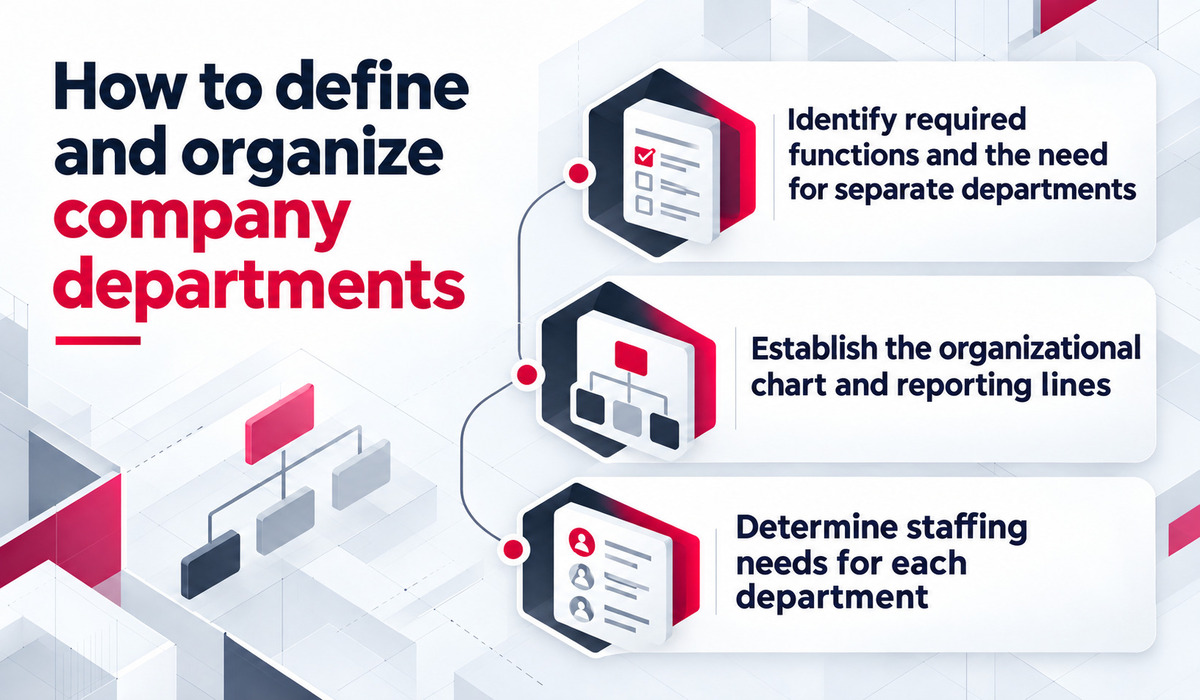
4.1. Identify required functions and whether they need separate departments
First, the company should identify the functions needed to support its operations and meet relevant legal obligations. Common functions include management, sales, accounting, human resources, and operational support. A manufacturing company may also need production management, procurement, warehousing, and quality control.
Next, the company should assess the workload, expertise required, and need for separate management of each function. Some functions can be combined in one department or assigned to a qualified external provider. When the workload grows or a function requires specialized oversight, the company may establish a separate department.
4.2. Establish an organizational chart and reporting relationships
An organizational chart shows management levels, specialist departments, and reporting relationships within a company. It typically lists governing bodies or leadership roles, direct managers, and each unit’s reporting line. Depending on management needs, it may also include subordinate teams and the number of positions.

Reporting relationships show who directly manages each unit. They are different from working relationships between departments. Two departments may report to the same level while performing different tasks. When planning office space, an organizational chart showing the management structure can inform the office design and build plan.
4.3. Determine staffing needs for each department
Staffing needs are determined by workload, task complexity, and the capabilities required. A company can assess the following factors:
- Workload: Number of tasks, time required, and how much the workload fluctuates.
- Expertise required: Task complexity and the capabilities needed for each role.
- Coordination capacity: The capabilities of existing staff and how responsibilities are allocated among them.
- Available resources: Staffing budget, business plans, and the ability to use external services.
When workloads change frequently, a company can adjust task assignments before hiring additional staff. Staffing levels should reflect actual needs instead of applying a fixed number to every department.

5. Ways to organize and coordinate departments
A company can retain its departmental structure while adjusting how teams coordinate. Options include cross-functional teams, remote work, and outsourcing specialist functions. Management software and artificial intelligence (AI) can help consolidate information, track work, and analyze data. Their use depends on implementation conditions and the company’s ability to manage them.
5.1. Cross-functional teams
A cross-functional team brings together employees from several departments to work toward a shared task or goal. For example, product development may require coordination between R&D, production, marketing, and sales. Each member contributes according to their expertise and assigned responsibilities.
The company should appoint a team lead, define each member’s responsibilities, and agree on how to resolve issues between departments. A team may operate for a specific project or on an ongoing basis.
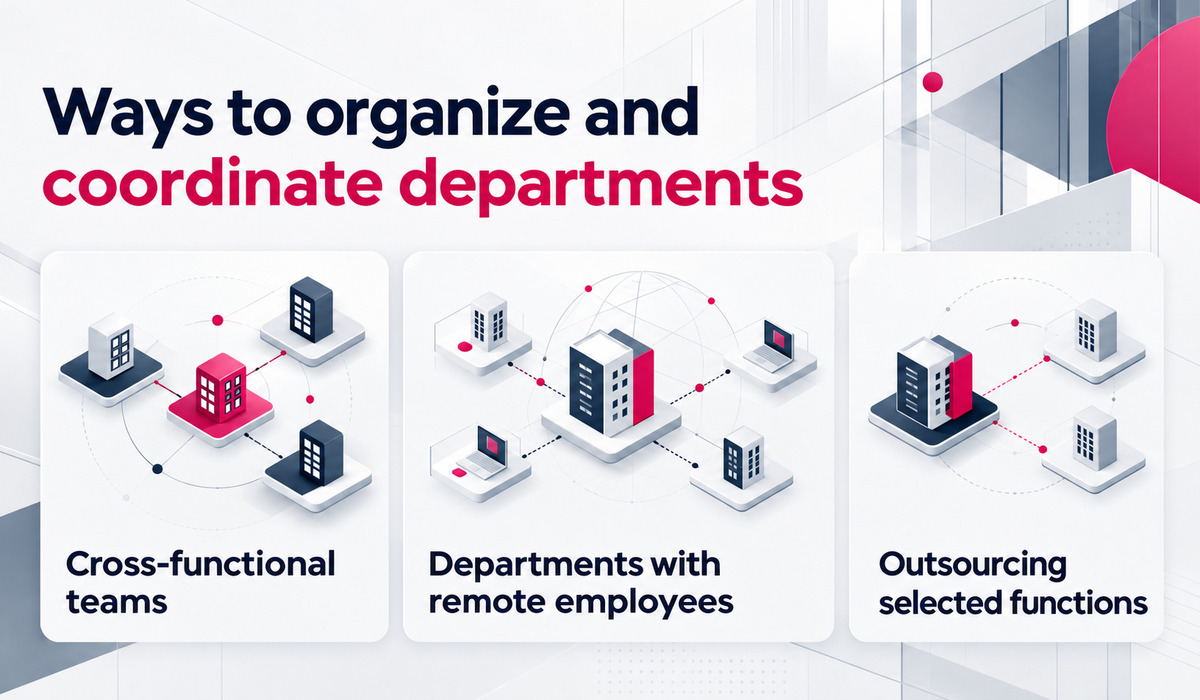
5.2. Departments with remote employees
A department can have employees working from different locations while maintaining consistent functions and management relationships. Employees typically use communication tools, project management software, and document-sharing systems to coordinate their work.
The company should agree on responsibilities, communication practices, coordination hours, and information security requirements. Remote work feasibility depends on the nature of the work and operating conditions. Roles that require on-site equipment, physical records, or face-to-face customer meetings may need separate arrangements.
5.3. Outsourcing selected functions
Outsourcing means assigning part of the company’s work to a service provider under an agreed scope. Functions that may be outsourced include accounting, information technology, marketing, customer service, and some facilities support activities. For services subject to specific legal requirements, the company should check the applicable conditions before selecting a provider.
When choosing an outsourcing service, the company should assess the following:
- Provider capabilities: Ability to meet the expertise requirements and scope of work.
- Cost and quality: Service costs and the quality commitments provided.
- Information security: Information protection requirements when working with the provider.
- Coordination and handover: Coordination responsibilities, handover scope, and how results will be assessed.
Outsourcing can give a company access to appropriate specialist capabilities. Cost effectiveness depends on the contract terms and actual workload.

A company’s departmental structure should reflect its functions, workload, and actual coordination needs. When creating or adjusting a department, the company should define its responsibilities, manager, and resources. If a structural change affects office use, information about staffing and working relationships can help determine space requirements.
6. Frequently asked questions about company departments (FAQ)
6.1. How many departments does a small company need?
There is no fixed number of departments that applies to every small company. A business can combine administration and HR or assign multiple functions to one employee if the workload and capabilities allow. Whether to establish separate departments depends on expertise requirements, management responsibilities, and relevant legal obligations.
6.2. Can a company change its departmental structure?
Yes. A company can adjust its structure when its strategy changes, it expands, or new management needs arise. Changes may include reallocating duties, establishing a new department, or combining functions. Changes affecting governance, personnel, or authority must comply with the law, the company charter, and internal policies.
6.3. Which department is the most important in a company?
No single department is the most important for every business. Priorities depend on the industry and business model. A trading company may prioritize sales and customer service, while a manufacturing company may focus on production and quality. Finance, accounting, HR, and compliance functions should be organized according to legal obligations and operational needs.
6.4. How should a startup organize its departments?
A startup can assign employees based on its products, customers, and resources. One team may handle both sales and marketing. Accounting, administration, or legal work can be assigned to internal staff or outsourced to a provider that meets the applicable requirements. As the business grows, it should assess the workload before separating functions into dedicated departments.
6.5. Do branches of the same company need to have the same departments?
No. Branches may have different departmental structures based on their functions, operating scale, and local customer needs. A company may centrally manage finance, HR, or IT. The delegation of responsibilities and authority must align with the law and the company’s management structure.