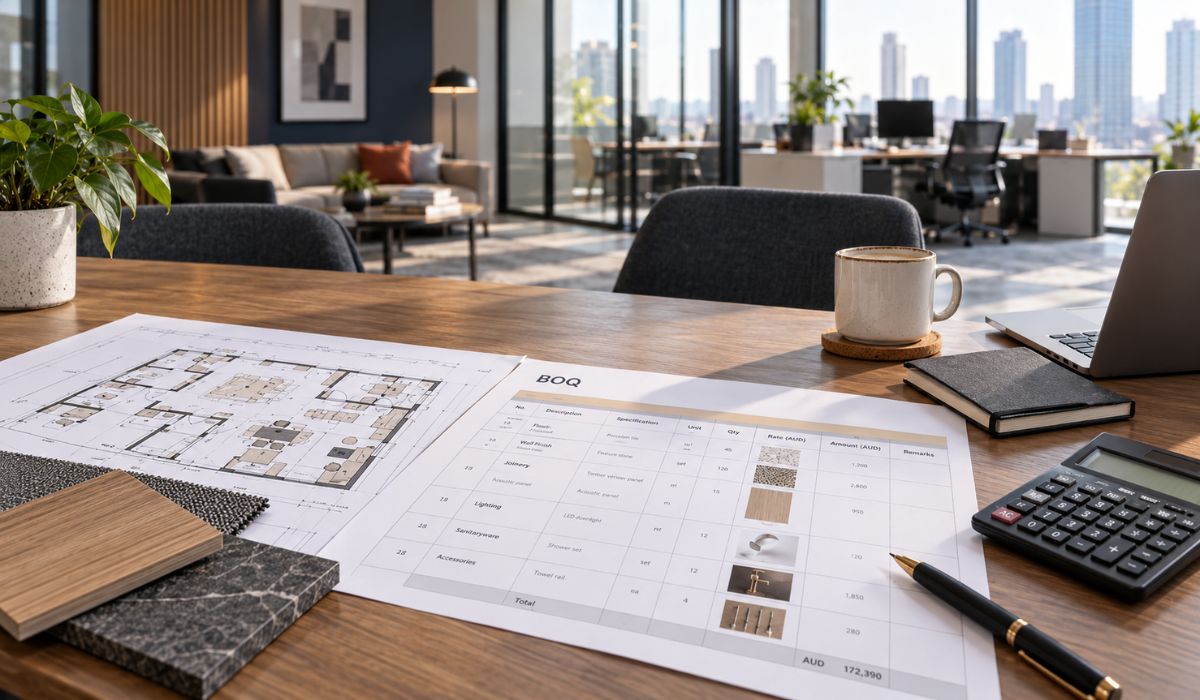
An office fit-out BOQ helps businesses track the scope of work, quantities, materials, and value of each item before construction begins. Reading it correctly helps identify unclear descriptions, quantities that need cross-checking, and scope that requires confirmation before signing a contract, accepting completed work, or managing changes during office design and build.
1. What is an office fit-out BOQ?
An office fit-out BOQ (Bill of Quantities) is a document used to describe and quantify work items in an office interior project. Depending on the documentation and project stage, it may include item codes, work descriptions, units of measurement, quantities, specifications, unit rates, line totals, and relevant notes.
2. The role of a BOQ in interior design and build
A BOQ provides a common basis for businesses, designers, contractors, and procurement teams to cross-check quantities, materials, and the scope of work. It is most effective when items are clearly described, quantities are supported by documentation, material specifications are detailed, and the scope is agreed upon in the contract documents.
2.1. A basis for budget planning and control
A BOQ breaks down the budget by work item, helping businesses understand the costs of finishing works, furniture, building services, and supporting activities. When the design changes, businesses can use the BOQ to identify the affected work categories. Budget updates should reflect the revised scope and the confirmed document revision so that any cost differences can be explained.
2.2. A tool for comparing quotations
Quotations should be compared using the same scope of work, material specifications, and construction conditions. Differences in unit rates may result from different materials, supporting work, or exclusions.
Businesses need to review each item’s description, quantity, unit of measurement, and scope together. Comparing only total prices or individual unit rates can lead to inaccurate assessments when quotations are prepared on different bases.
2.3. Clarifying material and construction standards
A BOQ may specify materials, dimensions, product codes, construction details, or references to drawings and technical requirements. This information helps the parties establish a consistent basis for pricing, procurement, and construction.
For items with detailed technical requirements, businesses should read the BOQ descriptions alongside the corresponding drawings, material schedules, and technical documents. BOQ descriptions typically do not contain all the project’s technical requirements.
>> Read more: Attractive and modern office design drawings
2.4. Controlling variations and changes
A BOQ records the agreed scope and quantities at a specific revision. When the design, materials, or quantities change, the parties can compare BOQ revisions to identify the affected items.
Effective variation control depends on changes being clearly described, approved, and incorporated into the contract documents. The BOQ revision used must correspond to the confirmed scope.
2.5. Supporting scheduling and procurement
BOQ quantities and work categories support material procurement planning, ordering, and tracking implementation requirements. Items that require custom manufacturing or have long lead times can be identified early and coordinated with the project schedule.
The BOQ also provides input for scheduling. The schedule itself still needs to show the sequence of work, approval periods, procurement lead times, and dependencies between activities.
2.6. Reducing the risk of disputes
Clear descriptions of scope, materials, quantities, and exclusions help prevent different interpretations of the same item. This is particularly important when several contractors or building services systems are involved in a project.
The risk of disputes increases when the drawings, BOQ, and contract reflect different scopes or document revisions. Before signing the contract, businesses should cross-check these documents to confirm that they establish a consistent basis for execution.
2.7. A basis for contracts and payment
The parties may incorporate the BOQ into the contract or an appendix to clarify the scope, quantities, and value of the work. Its role in acceptance and payment depends on the contract type, contract documents, and agreed conditions.
Businesses should read the BOQ alongside the clauses covering acceptance, payment, and scope changes. Its use during each acceptance and payment stage must follow the signed contract.
3. What work categories does an office fit-out BOQ include?
An office fit-out BOQ is typically divided into work categories to help businesses track scope, costs, and acceptance. These categories may vary depending on the design, construction scope, and project requirements.
Common work categories include:
- Architectural finishes: Office ceilings, partitions, flooring, painting, and other surface finishes.
- Woodwork and custom-made furniture: Reception counters, filing cabinets, workstations, pantry fittings, and items manufactured from detailed drawings.
- Meeting rooms, phone booths, and functional spaces: Typically includes partitions, doors, finishes, furniture, and related sound absorption, sound insulation, or building services requirements.
- MEP systems associated with the fit-out: Electrical installations, lighting, power outlets, data networks, supplementary air conditioning, and technical installations serving the workspace.
- Supporting work and overheads: May include transportation, after-hours work, protective screening, post-construction cleaning, and management of the construction area.
Depending on the project’s scale and requirements, the BOQ may be further divided by floor, area, or work package. Businesses should check the scope of each category to reduce the risk of work appearing under multiple items or being omitted.
4. The standard structure of an office fit-out BOQ
An office fit-out BOQ is typically arranged in columns that identify each item, its scope, quantity, and corresponding value. The exact structure may vary between projects, but it should be clear enough to cross-check against design documentation, quotations, and related documents.
4.1. No. / Item code column
The No. / Item code column assigns a number or code to each BOQ item. Item codes help with:
- Referencing items during discussions between the parties.
- Tracking the scope of work in project documents.
- Identifying the correct item when quantities or scope are revised.
For BOQs with multiple work categories, item codes may follow a work breakdown structure (WBS). This coding groups items such as ceilings, partitions, flooring, woodwork, and MEP systems for easier reference.
4.2. Item description
The item description column explains the work to be performed and its corresponding scope. Clear descriptions help businesses compare quotations, check materials, and establish each party’s responsibilities.
A description typically needs to identify:
- The item name.
- Material specifications and primary construction details.
- The scope of work included.
- Relevant drawings or technical requirements.
Descriptions that are too brief or generic can lead to different interpretations of the scope. For items with detailed technical requirements, the BOQ should be read alongside the corresponding drawings and technical documents.
4.3. Unit of measurement
The unit of measurement indicates how the quantity of each item is measured. Common units in an office fit-out BOQ include:
- m²: Ceilings, flooring, and partitions.
- m or linear m: Trims, skirting, and decorative slats.
- Set / each: Doors, lights, and equipment.
- Lot: A combined work package.
For items measured as a “lot,” businesses should check the work included and the acceptance method. A more detailed scope makes it easier to verify quantities and values.
4.4. Quantity
BOQ quantities are determined using documentation appropriate to each item. Sources for cross-checking may include:
- Floor layouts.
- Reflected ceiling plans (RCPs).
- Partition and woodwork details.
- Relevant technical drawings.
When reviewing quantities, businesses should check the scope by area, the quantity take-off method, and any items that have been grouped together. Quantities without an identifiable basis should be checked against the design documentation before the BOQ is finalized.
4.5. Unit rate
The unit rate represents the price per unit of quantity for the defined scope. Depending on the quotation and contract, it may include materials, labor, installation, finishing, or other related costs.
When reviewing unit rates, businesses should clarify:
- The work and materials included in the rate.
- Any excluded costs.
- Construction conditions that affect pricing.
Unit rates should be compared using the same scope and material specifications. A difference between two prices cannot be fully assessed if the items include different work.
4.6. Line totals and summary rows
The line total for each item is typically calculated as follows:
Line total = Quantity × Unit rate
A BOQ may also show:
- Subtotals by work category.
- Subtotals by area, where the documentation uses this breakdown.
- The total value of the scope of work.
The summary helps businesses understand the value of each category before reviewing individual items. Taxes, discounts, and separate charges should be clearly identified where applicable.
4.7. Notes and drawing references
The notes and drawing references column connects the BOQ to the documents that define the scope and technical requirements. It commonly includes:
- Relevant drawing numbers.
- Applicable technical requirements or standards.
- Construction conditions.
- Excluded scope.
References help readers check a BOQ item against the correct drawing or technical document. Where documents have undergone several revisions, businesses should check the BOQ and drawing revisions in use before confirming the scope.
5. An eight-step process for beginners reading an office fit-out BOQ
Beginners should review a BOQ in sequence, starting with the contract scope and cost breakdown before moving on to drawings and related conditions. This approach establishes the scope before examining quantities, unit rates, and individual work items.
5.1. Step 1: Review the scope and contract type
Before reading individual BOQ lines, businesses should identify the scope of work and the applicable contract type. Two points need clarification:
- Construction scope: The entire office, a partial area, or renovation work.
- Contract type: Lump sum, unit rate, or payment based on actual measured quantities.
The contract type affects how the BOQ is used for scope management, acceptance, and payment. It should therefore be read alongside the contract terms to establish the role of quantities and unit rates.
5.2. Step 2: Read the cost summary by work category
The summary shows the value of each work category before the reader examines individual items. Businesses can focus on:
- The total value of the interior scope.
- The value of each work category.
- Categories requiring closer checks of quantities or scope.
Ceilings, partitions, flooring, woodwork, and building services are often presented as separate BOQ categories. The exact structure depends on the project’s design and scope.
5.3. Step 3: Cross-check the BOQ against the floor layout
The BOQ should be checked against the floor layout to review items within each functional space. This can be done in the following order:
- Divide the office into functional areas.
- Check that the BOQ includes the corresponding items for each area.
- Verify areas, room counts, and the scope of work.
Reviewing the BOQ by area helps identify spaces with missing items or cases where several areas have been combined into one line without a clear scope description.
5.4. Step 4: Check ceilings and floors against the RCP
The reflected ceiling plan (RCP) provides a basis for checking items related to ceilings, lights, air terminals, and ceiling-mounted equipment.
When reviewing ceilings, clarify:
- Ceiling types, elevations, and construction scope.
- The locations of lights, air terminals, and related building services equipment.
For flooring, businesses should check:
- The area covered by each material.
- Transition locations and finishing details.
Flooring should be checked against the relevant finish drawings or material documentation. The RCP primarily supports checks of ceiling-related items.
5.5. Step 5: Review partitions, meeting rooms, and phone booths
Partitions, meeting rooms, and phone booths often involve multiple construction layers, finishing materials, and technical requirements. When reading the BOQ, businesses should check:
- The extent of partitions and related construction details.
- Sound absorption or sound insulation requirements, where applicable.
- Whether meeting rooms and phone booths have been appropriately itemized.
- Associated finishing and building services requirements.
Clearly separating each component helps businesses establish the construction scope and makes cross-checking easier during acceptance.
5.6. Step 6: Check MEP against the technical drawings
Mechanical, electrical, and plumbing (MEP) items should be read alongside the technical drawings to establish the execution scope. Businesses should clarify:
- Lighting power, power outlets, and data networks.
- Alterations or additions to existing installations.
- The scope associated with air conditioning and building services systems.
- The division of responsibilities between the interior fit-out contractor and other specialist contractors.
Responsibilities should be clearly defined in the BOQ or related documents. This helps prevent the same work from being included in multiple packages or falling outside every contractor’s scope.
5.7. Step 7: Review units, specifications, and inclusions
After checking the drawings, businesses should review each BOQ line in detail. The three main points are:
- The unit of measurement for each item.
- Material specifications and construction details.
- Inclusions and exclusions.
Items using combined units such as “lot,” or those with brief descriptions, require scope clarification before the contract is signed. Where the BOQ references drawings or technical documents, businesses should check that the applicable revisions are being used.
5.8. Step 8: Confirm acceptance, warranty, and variation procedures
The final step focuses on the conditions governing acceptance, warranty, and change management. Businesses should establish:
- How work will be accepted by item or measured quantity.
- Warranty periods and coverage.
- How additional work will be recorded and approved.
- How the BOQ will be updated when the design or scope changes.
Acceptance, warranty, and variation provisions should be checked against the contract and relevant appendices. The BOQ defines scope and quantities to the extent agreed in the contract documents.
6. Office fit-out BOQ terminology beginners should know
BOQ terminology commonly relates to work breakdowns, scope, drawings, and contract types. Understanding these terms helps businesses communicate more clearly with contractors and avoid misinterpreting the documents.
| Term translated from Vietnamese | English terminology | Meaning | Example |
|---|---|---|---|
| BOQ | Bill of Quantities | A document listing and quantifying work items. | A BOQ for a 200 m² office fit-out. |
| Work item | Work item / Item description | A work activity or furniture product listed separately in the BOQ. | “12 mm tempered glass partition,” “MDF filing cabinet.” |
| Specifications / Technical description | Specification | Details of the materials, dimensions, standards, and brands associated with an item. | “An Cường MDF board, 18 mm thick, with a melamine finish.” |
| Unit of measurement | Unit | The unit used to measure quantities in the BOQ. | m², linear meters (m), each/set, lot, kg. |
| Measured quantity / Item count | Quantity | The actual quantity of an item expressed in its unit of measurement. | 45 m² of glass partitions, 12 filing cabinets. |
| Unit rate | Unit rate / Unit price | The price per unit of quantity, excluding or including tax according to the stated convention. | VND 1,200,000/m² of glass partition. |
| Line total | Amount / Line total | The total value of one item line = unit rate × quantity. | 45 m² × VND 1,200,000/m² = VND 54,000,000. |
| Total estimated cost | Total estimated cost | The sum of all line totals in the BOQ, which may exclude taxes and fees. | Total BOQ value: VND 450,000,000. |
| Main materials | Main materials | The primary materials making up an interior item. | Wood-based boards, glass, gypsum board, paint, carpet. |
| Accessories | Accessories / Fittings | Components used to complete a furniture item. | Hinges, ball-bearing drawer slides, handles, adjustable feet. |
| Labor | Labor cost | The labor cost of constructing or installing an item. | VND 150,000/m² for gypsum partition installation. |
| Construction machinery and equipment | Plant & equipment | Costs associated with machinery and equipment used for construction. | Cutting machines, screw guns, scaffolding. |
| Overheads / Management costs | Overheads / Preliminaries | Costs for project management, occupational safety, cleaning, protection of existing conditions, and related activities. | 5–10% of the total contract value. |
| Value-added tax | VAT | Value-added tax applied to the total BOQ value. | Pre-tax total: VND 450 million; VAT at 10% = VND 45 million. |
| Provisional allowance / Contingency | Provisional sum / Contingency | An allowance for items with uncertain quantities or potential additional work. | A 5% contingency for electrical variations. |
| Variations | Variation / Variation order (VO) | Changes to the original BOQ scope that result in adjustments to quantities or unit rates. | Adding 10 data outlets and two glass partitions. |
| Verification of completed quantities | Measurement / Take-off verification | Measuring and confirming actual completed quantities for payment. | Accepting 42 m² of partitions instead of the 45 m² listed in the BOQ. |
| Warranty | Warranty | A commitment defining the warranty period and coverage for an item or material. | A 12-month warranty for wooden cabinets and a 24-month warranty for glass. |
| Exclusions | Exclusions | Work or materials not included in the BOQ. | Excludes movable desks and chairs, plants, and fire protection works. |
| Notes / Applicable conditions | Notes / Terms & conditions | Notes on construction standards, timing, protection of existing conditions, schedules, and related matters. | “The price excludes transportation to upper floors.” |
7. Seven common mistakes beginners make when reading an office fit-out BOQ
Beginners often focus heavily on price while overlooking scope, drawings, and acceptance conditions.
Common mistakes when reading an office fit-out BOQ include:
- Focusing on the total value and overlooking the cost breakdown: The total price does not show which items account for a difference. Businesses should therefore review the value of each work category.
- Failing to cross-check the BOQ against the floor layout: Checking each functional space helps identify missing items or areas that have been grouped together.
- Ignoring the RCP when checking ceilings and equipment: Ceilings, lights, air terminals, and building services equipment are directly related. The BOQ should be checked alongside the ceiling plan and relevant technical documents.
- Accepting overly general item descriptions: Descriptions that omit specifications, construction details, or inclusions can lead to different interpretations of the same work.
- Failing to clarify items measured as a “lot”: This unit is suitable for some combined work packages, but the scope must be clearly described. For items with multiple components, a detailed breakdown makes pricing checks and acceptance easier.
- Failing to define the division between interior and MEP work: Unclear scope may cause work to appear in several packages or be omitted. Businesses should establish each contractor’s responsibilities using the BOQ and technical documentation.
- Overlooking acceptance, warranty, and variation conditions: Acceptance, warranty, and scope change provisions should be checked against the contract and relevant appendices.
Reading the BOQ alongside drawings, technical requirements, and the contract allows businesses to review each item more thoroughly. Before execution begins, each work item should have a defined scope, supporting documentation, and clearly assigned responsibilities.
8. Office fit-out BOQ checklist before signing a contract
Before signing a contract, businesses should cross-check the BOQ against the design documentation and relevant terms. This checklist helps identify missing, inconsistent, or unclear information before the scope and value of the work are finalized.
| Check item | What to confirm | Points to clarify |
|---|---|---|
| Scope of work | Does the BOQ cover all areas and items within the construction scope? | Clearly define inclusions and exclusions. |
| Consistency with design documentation | Do quantities, locations, and dimensions match the drawings and technical documents? | Flag omissions, excess quantities, and inconsistencies. |
| BOQ structure | Does the BOQ include item codes, descriptions, specifications, units, quantities, unit rates, line totals, and notes? | Check for missing information fields. |
| Units of measurement | Are units appropriate for each type of work and used consistently? | Clarify items using combined units such as “lot.” |
| Quantities | Can quantities be checked against areas, item counts, and relevant drawings? | Request explanations for significant differences. |
| Material specifications | Are material types, dimensions, construction details, product codes, or technical requirements clearly stated? | Clarify information that remains general or undefined. |
| Accessories and fittings | Are types, codes, quantities, and technical requirements specified? | Avoid general descriptions such as “premium fittings.” |
| Unit rates | Which materials, labor, and activities are included in each unit rate? | Identify costs excluded from the price. |
| Taxes and fees | Does the BOQ clearly distinguish pre-tax prices, taxes, and related fees? | Cross-check against the contract and regulations applicable at the time of signing. |
| Provisional sums | Are items with insufficient information clearly marked as provisional? | Establish the conditions and method for updating values once sufficient information is available. |
| Variations and changes | Do the documents explain how changes are recorded, approved, and priced? | Identify the approver and the documents requiring updates. |
| Construction schedule | Are quantities and work categories linked to relevant implementation milestones? | Cross-check against the project schedule or schedule appendix. |
| Payment terms | Do payment milestones align with the agreed scope and acceptance conditions? | Check payment percentages, milestones, and required documents for each payment. |
| Acceptance | Are acceptance conditions clearly defined for each work category? | Reference drawings, technical requirements, or related documents where necessary. |
| Warranty | Are warranty coverage and periods specified in the BOQ, contract, or appendices? | Clearly identify the relevant work categories and applicable conditions. |
| Material and fitting samples | Does the project require sample approval before manufacturing or installation? | Identify approved samples and how they will be checked during acceptance. |
| Transportation and protection of existing conditions | Have transportation, protective screening, and protection of the construction area been included in the price? | Check any additional building requirements. |
| Construction safety and fire protection | Which scope covers safety and fire protection requirements, and are they included in the price? | Clarify whether they are covered by overheads or listed separately. |
| Total value calculations | Does each line total match its quantity and unit rate? | Check category subtotals and the overall BOQ value. |
| Consistency with the contract | Are the BOQ’s scope, prices, payment terms, acceptance provisions, and warranties consistent with the contract? | Resolve differences before signing. |
Businesses should cross-check the BOQ against the scope of work, design documentation, and contract conditions before confirming it. Items with unclear quantities, specifications, references, or execution scope should be checked and agreed upon before work begins.
9. Frequently asked questions about office fit-out BOQs (FAQ)
9.1. What is the difference between a BOQ and a BOM?
A BOQ presents the quantities and scope of project work items, while a BOM (Bill of Materials) lists the materials and components required for manufacturing or assembly. In office interior projects, a BOQ is commonly used to manage the scope and value of work, while a BOM is more suited to woodwork manufacturing and material preparation.
9.2. When should a business request a BOQ?
Businesses should request a BOQ when an office project includes numerous built-in furniture items, requires comparisons between contractor quotations, or needs budget control and fewer variations. A BOQ is particularly important for turnkey construction, projects with multiple rooms or functional areas, and clients seeking clear acceptance and payment based on actual measured quantities.
9.3. Must a BOQ be accompanied by a technical specification?
Not every BOQ requires a separate technical specification document. Material, construction, and finishing requirements may be included in the BOQ or related technical documentation. For complex items, a separate technical document helps the parties establish the standards to be applied.
9.4. What is the quickest way to check a BOQ for duplicated or missing items?
Businesses can check the BOQ by functional area against the floor layout, ceiling plans, and technical drawings. They should then review the division between finishing works, furniture, and MEP to identify work duplicated across categories or items shown on the drawings but missing from the BOQ.
9.5. Is a BOQ needed for acceptance and payment under a lump-sum contract?
A BOQ may be used under a lump-sum contract to define the scope, work items, and basis for managing changes. Acceptance and payment procedures depend on the terms and documents of the signed contract. Businesses should therefore read the BOQ alongside the provisions governing acceptance, payment, and scope changes.