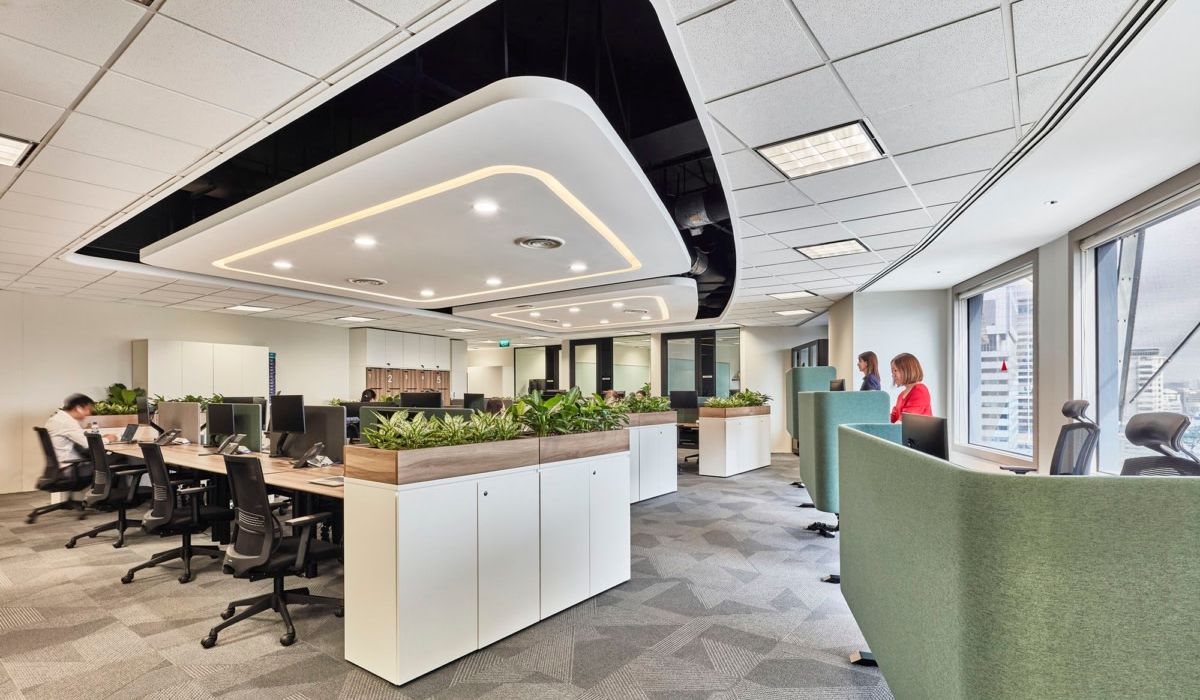
LCA for office interior materials helps businesses examine the environmental impacts of flooring, partitions, ceilings, and furniture within a defined assessment scope. When selecting materials for a new project or renovation, businesses can use LCA results to identify the stages that generate impacts and check the underlying data before comparing options.
1. What Is Life Cycle Assessment (LCA)?
Life Cycle Assessment (LCA) is a method for compiling an inventory of inputs and outputs and evaluating the potential environmental impacts of a product system. Depending on the study objectives, the scope may cover everything from raw material extraction to end-of-life treatment or focus on selected stages.
2. Office Interior Materials Included in an LCA
In renovation projects, the assessment inventory may include both newly installed materials and existing elements intended for retention. The office design and build company can organize the inventory by assembly to make it easier to cross-check against drawings and quantities.

- Flooring, ceilings, and partitions: Record finishes and associated components within the scope, such as flooring panels, underlay, partition framing, or office ceiling suspension systems.
- Built-in and loose furniture: List reception counters, cabinets, desks, and chairs by quantity, specification, or mass.
- Surface finishing materials: Specify paints, adhesives, glass, and metals for each item. If they are already included in a complete assembly, avoid entering them again as separate line items.
- Building services materials: Include wiring, pipes, or insulation when the assessment scope covers the relevant systems.
3. How Does LCA Support Office Material Selection?
LCA results show which stages contribute most to each environmental indicator. When comparing two flooring options, the design company can examine how each replacement affects the results over the intended service period. For existing partitions that still meet requirements, businesses can assess retaining them while accounting for any necessary repairs.
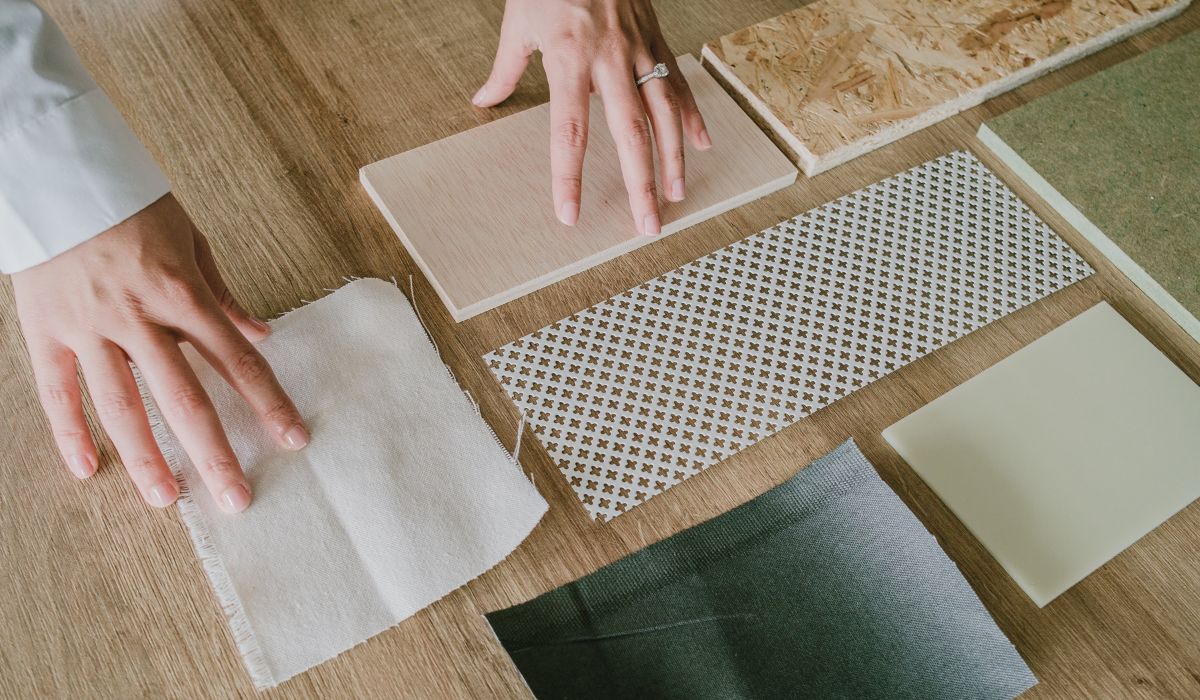
The assessment results also help procurement teams identify additional information needed from suppliers, such as expected service life or maintenance requirements. When reviewing budgets, businesses can prepare a separate life cycle cost table to compare purchase, maintenance, and replacement costs alongside environmental indicators.
4. Life Cycle Stages of Office Interior Materials
Two flooring products that meet the same functional requirements may produce different LCA results because they require different quantities of adhesive, maintenance schedules, or numbers of replacements. Dividing the life cycle into stages helps businesses identify where differences arise and what additional data is needed for comparison.
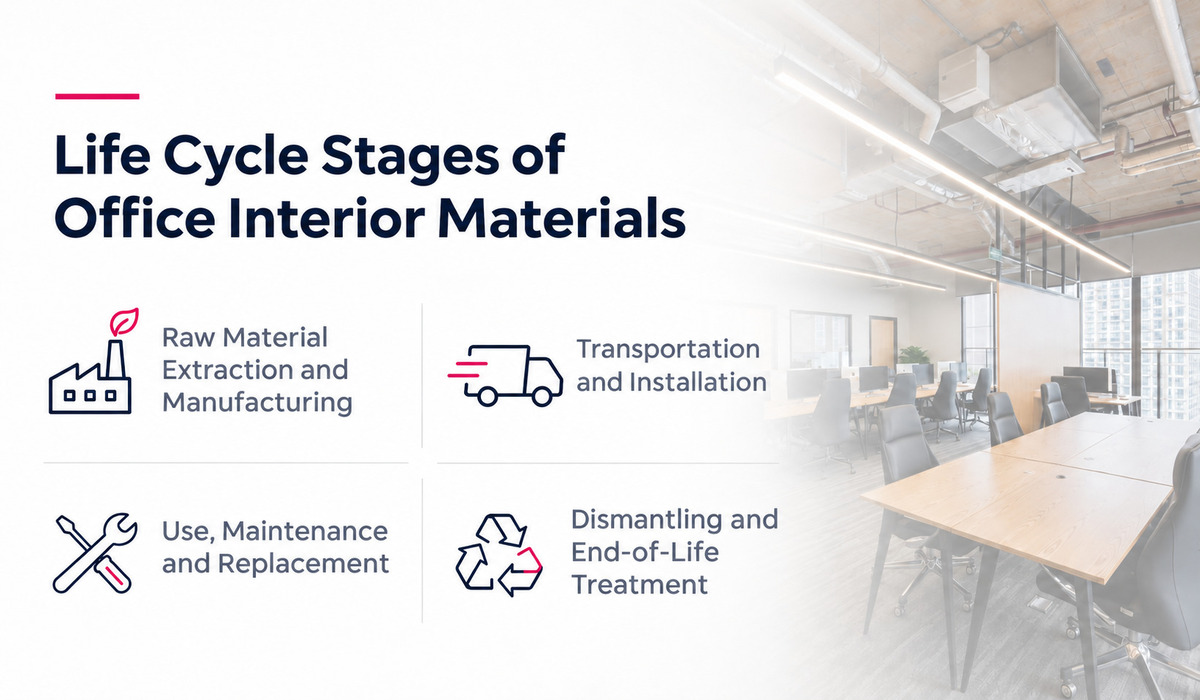
4.1. Raw Material Extraction and Manufacturing
For partition panels, environmental impacts at the manufacturing stage depend on raw material composition, transport distances to the manufacturing facility, and the energy used in processing. Even when two panels have the same dimensions, their core mass, surface finishes, and quantities of waste generated may differ.
When reviewing material documentation, businesses need to check whether the data covers the finished panel or only its core. If the documentation covers only the core, determine whether data on surface finishes or adhesives must be added so that both options are assessed on an equivalent assembly basis.
4.2. Transportation and Installation
Delivery impacts depend on distance, vehicle type, and the mass of materials transported. For materials delivered through multiple transport legs, the assessor needs to record legs using different transport modes separately to accurately represent the delivery route.

During installation, the finished floor area may be smaller than the area of flooring purchased because pieces must be cut around columns or along wall edges. When calculating installation impacts, record material wastage, adhesives, underlay, and the treatment of packaging and surplus materials according to the construction method.
4.3. Use, Maintenance, and Replacement
Maintenance schedules need to reflect how each area is used. Entrance flooring may require more frequent cleaning than flooring in meeting rooms. If the two options require different cleaning procedures, the assessor needs to specify cleaning frequency and the quantities of water, cleaning agents, or energy used over the same service period.
For modular flooring, the ability to replace only damaged sections depends on the fixing method and the availability of replacement units with matching specifications. When developing an option, businesses need to determine the area expected to be replaced each time and the number of replacements during the assessment period. These two inputs help estimate the additional materials required and the amount of removed flooring requiring treatment.
4.4. Dismantling and End-of-Life Treatment
Fixing methods affect the potential for material recovery. For screw-fixed partitions, the design company can check whether panels, framing, and fittings can be dismantled separately. If panels are bonded to a substrate, it is necessary to assess whether the materials can be separated in a condition suitable for reuse or recycling, or whether they need to be sent for treatment or disposal.
The end-of-life scenario needs to specify the recoverable portion of the materials, the receiving facility, transport distances, and the treatment of the remaining materials. If a receiving facility has not been confirmed, businesses should record the recovery rate as an assumption and examine how the results change if less material is recovered than expected.
5. LCA Assessment Scopes for Office Interior Materials
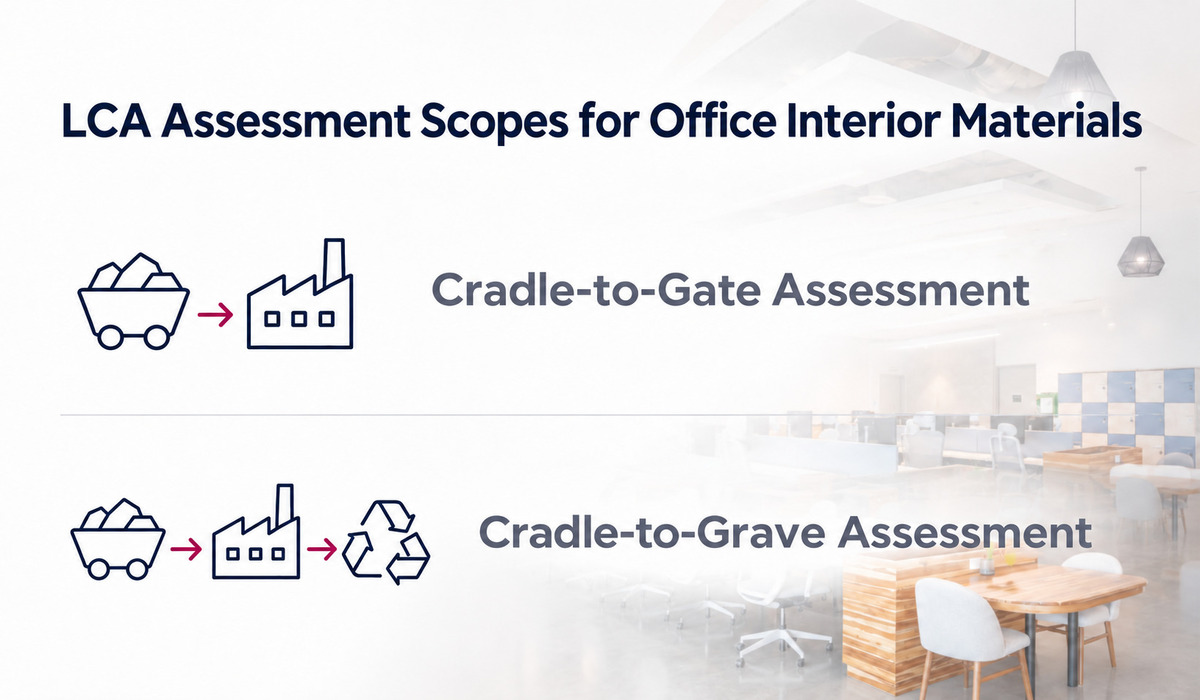
Before comparing materials, businesses need to identify the decision the results will support. When screening flooring products with the same function, data covering production up to the factory gate can provide a starting point. If two options differ in installation methods, service life, or recovery potential after dismantling, the scope needs to include the stages responsible for those differences.
5.1. Cradle-to-Gate Assessment
In declarations prepared according to EN 15804, the scope up to the factory gate corresponds to three modules. A1 covers raw material supply and processing, A2 accounts for transporting raw materials to the manufacturing facility, and A3 includes product manufacturing and packaging.
When comparing two flooring products, businesses need to check that the data uses the same units, calculation methods, and declared scope. If both sets of documentation cover only A1–A3, the conclusions are also limited to the product stage. Differences in delivery distances, installation adhesive quantities, or flooring replacements need to be assessed in the corresponding stages.
5.2. Cradle-to-Grave Assessment
The extended scope also accounts for transportation to the project site, installation, maintenance, repair, replacement, and treatment after dismantling. When comparing two flooring products, the assessor needs to use the same area, functional requirements, and analysis period. If one option requires earlier replacement, the results need to include the additional impacts of replacement flooring and the treatment of removed flooring.
If documentation prepared according to EN 15804 includes module D, businesses need to review the potential benefits and impacts beyond the system boundary separately. For example, the potential to use recovered metal framing as raw material for another product depends on the collection and recycling scenario. Module D results are presented separately from the total impacts within the life cycle scope being assessed.
6. The LCA Process for Office Interior Materials
Life Cycle Assessment (LCA) consists of four phases, from defining objectives to interpreting results. Each phase requires appropriate data and methods to assess the environmental impacts of materials and clarify the limitations of comparisons between options.
6.1. Goal and Scope Definition
First, define the assessment objectives, life cycle scope, and basis for comparing materials. For flooring, the functional unit could be 1 m² of installed flooring that meets the same technical requirements over a defined service period. This definition allows the options to be assessed on an equivalent basis.
6.2. Life Cycle Inventory
Life Cycle Inventory (LCI) involves collecting data on raw materials, energy and water use, emissions, and waste within the assessment scope. Data sources, measurement units, and calculation assumptions need to be documented clearly to ensure transparency and facilitate review.
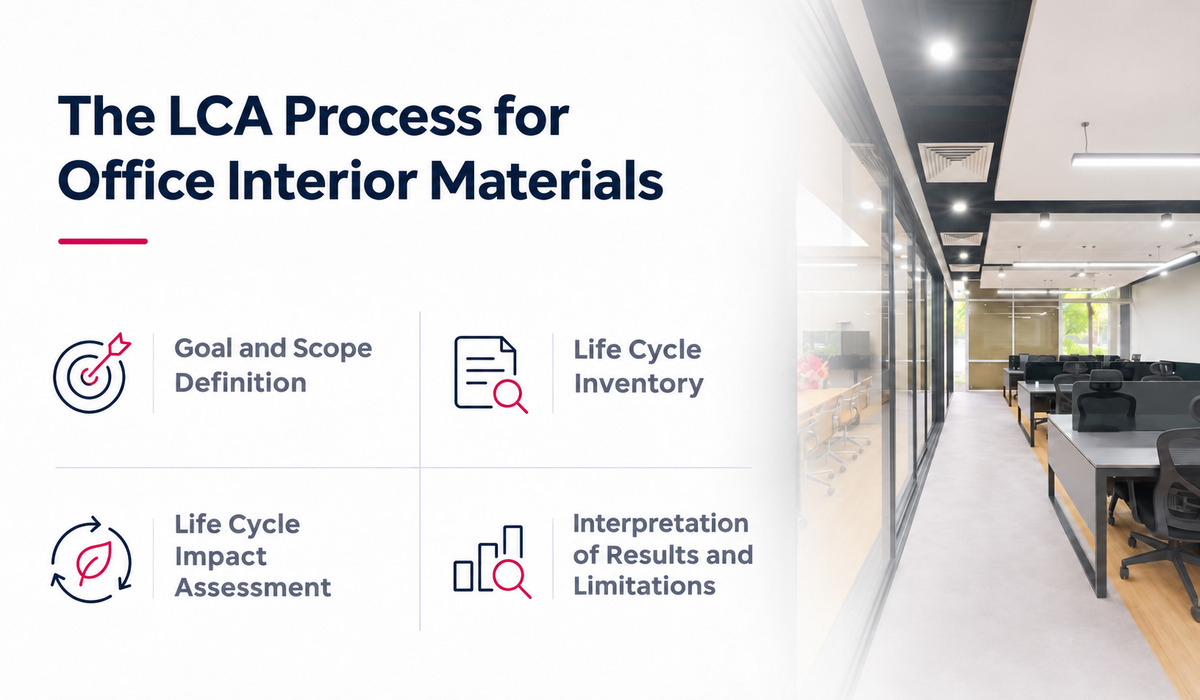
6.3. Life Cycle Impact Assessment
Life Cycle Impact Assessment (LCIA) uses inventory data to calculate indicators of potential environmental impacts. One commonly considered indicator is global warming potential (GWP), measured in kg CO₂ equivalent. Depending on the assessment objectives, indicators for acidification or eutrophication may also be included.
6.4. Interpretation of Results and Limitations
LCA results need to be analyzed to identify stages with significant environmental impacts and determine how calculation assumptions influence the findings. Material comparisons need to consider service life, conditions of use, and assessment scope. If changes to these factors alter the comparison results, the report needs to explain this so that businesses can make an informed selection.

7. Data Required for an LCA
To conduct an LCA, businesses need to collect information on materials throughout their life cycle, from manufacturing through use to treatment after dismantling. The interior bill of quantities (BOQ) helps identify material types, specifications, and quantities.
| Data Category | Required Documentation | Items to Check |
|---|---|---|
| Material types and quantities | BOQ, design drawings, and material schedule. | Product codes, assembly composition, and installed quantities. |
| Raw materials and manufacturing | Environmental Product Declarations (EPDs), manufacturing data, or LCA databases. | Assessment scope, data timeframe, and data relevance. |
| Transportation and installation | Transportation plans and construction documentation. | Distances, transport modes, ancillary materials, and wastage. |
| Use and replacement | Maintenance instructions and operational plans. | Conditions of use, expected service life, and number of replacements. |
| End of life | Plans for dismantling, material recovery, and treatment. | Potential for material separation, transport methods, and treatment after dismantling. |
When using industry-average data, assess its relevance to the product, manufacturing technology, and geographical area concerned. Assumptions about transportation, service life, and material treatment scenarios also need to be documented clearly so they can be adjusted if actual project conditions change.
8. How to Read an EPD for Office Interior Materials
An Environmental Product Declaration (EPD) provides information on a material’s environmental impacts based on Life Cycle Assessment (LCA) results. When using EPDs to compare materials, businesses need to check product information, assessment scope, and the indicators disclosed.
8.1. Check Product Information and Declaration Scope
First, cross-check the product name, code, specifications, and manufacturing facility listed in the EPD against the material intended for use. If an EPD covers multiple products, determine whether the data represents individual products or an average for the group. Next, check which life cycle stages are included in the EPD.
Note: Stages without data need to be recorded to avoid comparisons based on different data coverage.
8.2. Check Units, Indicators, and EPD Verification
Environmental indicators in an EPD may be calculated per 1 kg, 1 m², or another declared unit. For comparison, the results need to be converted to a common basis using product specifications and appropriate data. Businesses also need to check the Product Category Rules (PCR), calculation methods, life cycle scope, independent verification information, and EPD validity period.
9. How to Compare Two Material Options Using LCA Data
When considering two flooring products for the same work area, the design company needs to confirm that both meet the area’s technical requirements. A comparison table can be prepared as soon as the documentation is received to identify data requiring clarification before calculations begin.
9.1. Establish Common Functional Requirements and a Service Period
Use the same floor area, intensity of use, and assessment period for both options. Check whether each option meets the applicable requirements for durability, cleaning, and installation conditions. If one option requires earlier replacement, specify the expected number of replacements within the same analysis period.
9.2. Compare Scope, Data, and Replacement Scenarios
When the two sets of documentation have different scopes, compare the compatible portions of the data or add data to bring both options within the same scope. A checklist helps determine how to address each difference.
| Criterion | How to Check the Two Flooring Options |
|---|---|
| Material quantities | Use the same installed floor area as the basis. Include underlay, adhesives, and wastage according to the actual assembly where these fall within the scope. |
| Life cycle scope | Compare corresponding modules. If the common data covers only A1–A3, state that the results are limited to the product stage. |
| Methods and indicators | Check the compatibility of PCRs, calculation methods, and units. Review each indicator using the same method and scope. |
| Maintenance and replacement | Use the same assessment period. Record cleaning frequency, the extent of replacement, and the number of replacements separately for each option. |
9.3. Record Missing Information Before Selecting Materials
If an option lacks data on service life or installation adhesive quantities, the procurement team can request additional technical documentation. When a preliminary decision is needed, document the assumptions and test the results using other substantiated values. If the ranking of the two options changes with the assumptions, the data needs to be verified before drawing a conclusion.
10. Standards and Tools Commonly Used in LCA
LCA needs to be based on appropriate standards and data with clearly documented sources. Depending on the project objectives, businesses can use international standards, specialized software, and life cycle databases to assess the environmental impacts of materials.
10.1. LCA and Environmental Product Declaration Standards
Standards commonly used for LCA and environmental product declarations include:
- ISO 14040: Establishes the principles and framework for Life Cycle Assessment.
- ISO 14044: Sets out requirements for data collection, impact assessment, and interpretation of LCA results.
- ISO 14025: Establishes the principles and procedures for Type III environmental declarations (EPDs).
- EN 15804 and ISO 21930: Provide rules for developing EPDs for construction products within the scope of each standard.
For projects seeking LEED certification, businesses need to check the version and credit requirements under which the project is registered to determine the applicable EPD and material documentation requirements.
10.2. LCA Software and Databases
LCA software supports the calculation of environmental impacts across the life cycle stages of materials. LCA databases provide information on raw materials, energy, transportation, and related processes for use in those calculations.
When selecting tools, consider how well the data reflects material sources, manufacturing technologies, and actual project conditions. The software and database versions used also need to be documented clearly to facilitate review of the results.
Before making a material selection, businesses can start by comparing two options for the same item. Cross-checking product codes, quantities, technical requirements, and conditions of use helps identify missing data and establish an appropriate basis for assessment.
11. Frequently Asked Questions About LCA for Office Interior Materials (FAQ)
11.1. What Is the Difference Between LCA and an EPD?
LCA is a method for assessing environmental impacts within a defined life cycle scope. An EPD is a declaration that presents a product’s environmental results according to applicable rules, helping readers understand which product the data represents and which stages it covers.
11.2. Does LCA Assess Only Carbon Emissions?
LCA can examine multiple environmental impact categories, such as climate change, acidification, and eutrophication. If a project focuses on a product’s greenhouse gas emissions, its carbon footprint can be quantified within an appropriate scope, with ISO 14067 serving as a relevant standard.
11.3. Can Materials Be Compared If Only One Product Has an EPD?
A preliminary assessment is possible if suitable data is available for modeling the other option on the same basis. The report needs to document differences in data quality and test the sensitivity of the results. When compatible data is unavailable, the gaps should be recorded and additional information obtained before drawing a conclusion.
11.4. Does LCA Include Material Use and Replacement Costs?
To calculate use and replacement costs, businesses need to conduct a Life Cycle Costing (LCC) analysis. Both analyses can use the same assumptions for service period, maintenance schedules, and number of replacements. LCA expresses results through environmental indicators, while LCC expresses results in monetary terms.