Activity-Based Working (ABW) is a work model that lets employees choose spaces suited to their tasks instead of sitting at a permanently assigned desk. An ABW office includes areas for focused work, collaboration, and meetings. Before adopting the model, businesses should assess their workforce needs, existing floor plan, and operational readiness.
1. What is Activity-Based Working (ABW)?
Activity-Based Working (ABW) is a work model in which employees choose a space suited to each task instead of using a permanently assigned desk. An office typically combines shared desks with focus areas, spaces for group discussions, and private work areas. The layout is planned around the nature of the work, collaboration needs, and how often employees use each space.
2. Workspace types in an Activity-Based Working model
An ABW office includes different types of spaces for a range of work activities, from focused individual work to discussions and team meetings.
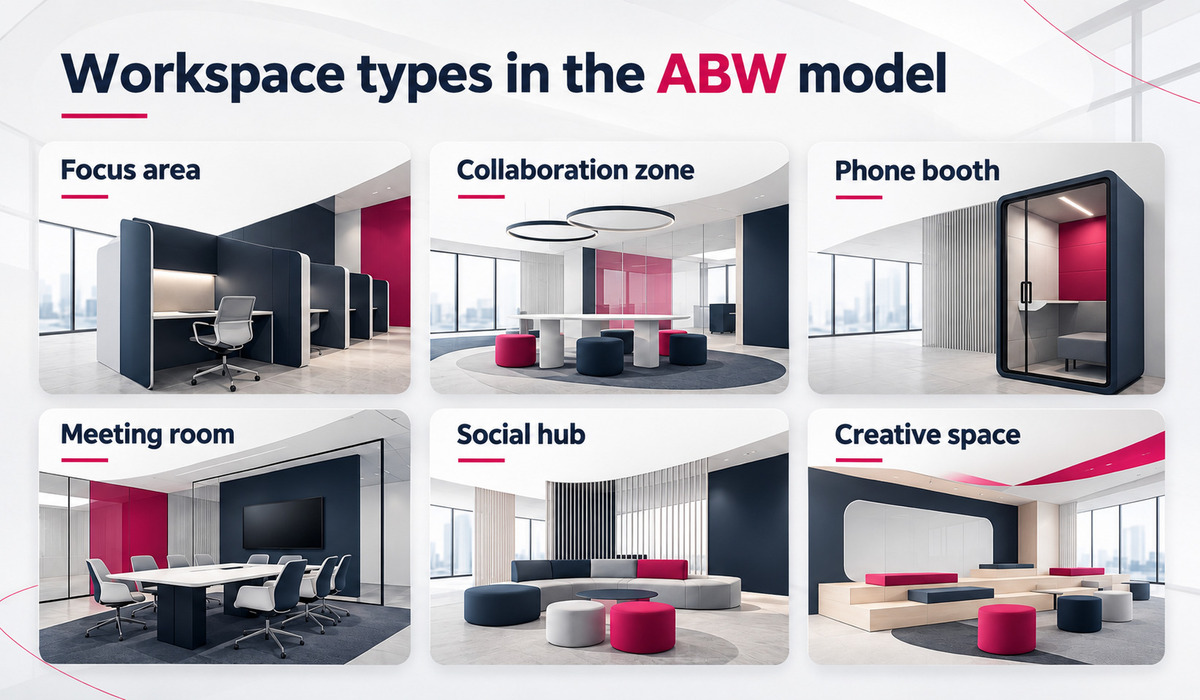
Depending on how the office will be used and its floor area, businesses can include:
- Focus room: Supports individual work that requires quiet and fewer interruptions.
- Collaboration zone: Includes group tables and discussion areas where employees can share ideas and coordinate work.
- Phone booth: Provides a place for calls or online meetings while limiting noise for nearby employees.
- Meeting room: Accommodates meetings with different requirements for attendance, duration, and privacy.
- Social hub: Provides space for short breaks, informal conversations, and shared employee activities.
- Creative space: Supports internal workshops, idea development, and discussions that benefit from a flexible layout.
In an Office Neighborhoods layout, businesses group spaces based on teams or the nature of their work. Each neighborhood may combine shared desks, focus areas, and discussion spaces. Employees mainly work within their team’s neighborhood and use other spaces as needed.
3. Principles for choosing and using spaces in ABW
In an ABW model, employees choose spaces based on the nature of the task, the level of interaction, and privacy requirements. Individual work that requires quiet is generally suited to a focus area. Team discussions can take place in a collaboration zone, while confidential meetings require a private room.
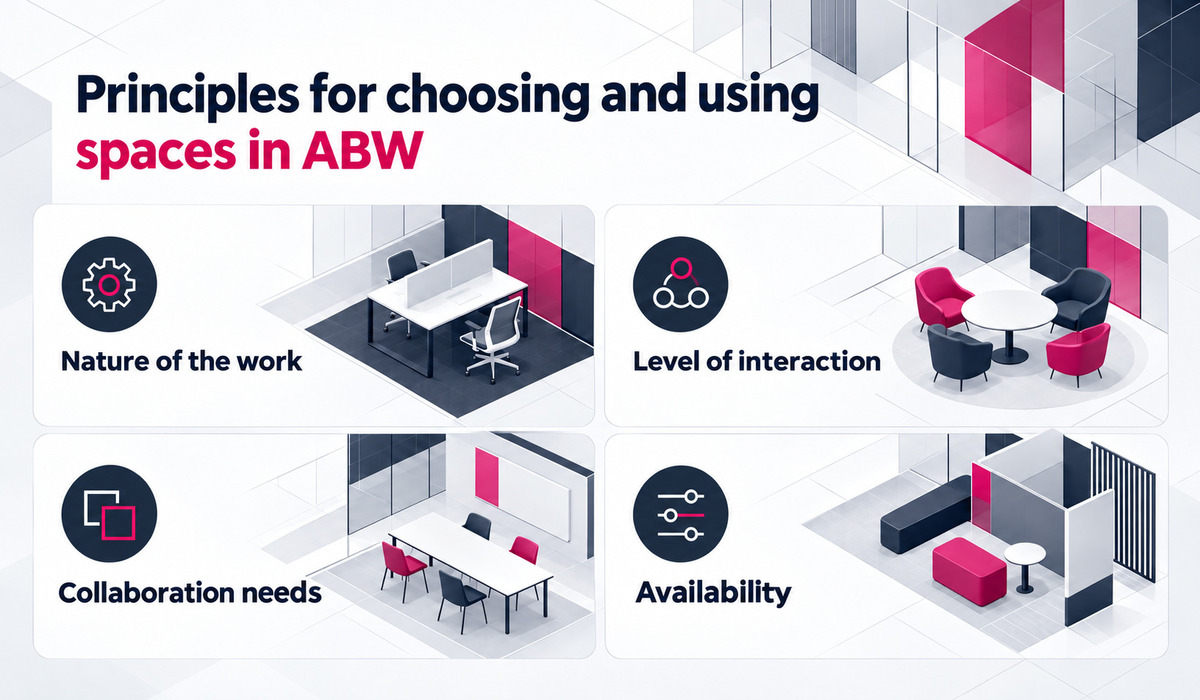
Key principles for using the spaces include:
- Nature of the work: Choose a space suited to focused work, discussion, or privacy.
- Level of interaction: Keep activities involving frequent discussion away from areas that need to stay quiet.
- Collaboration needs: Place employees near their teams when they need to work together.
- Availability: Check the number of open seats and the expected duration of use.
For teams that collaborate frequently, businesses can create team neighborhoods to make discussions easier. When tasks change, employees can still move to other functional spaces.
The choice of space also depends on seat availability and actual usage. If focus areas are often full or meeting rooms lack capacity, businesses should review the space allocation before changing employees’ usage habits.
4. How ABW differs from other work models and office layouts
ABW is related to several approaches to organizing work and arranging offices, but each focuses on different needs. Before choosing a model, businesses should distinguish between the way employees work, how they use desks, and how the floor plan is organized.
4.1. ABW and hot-desking
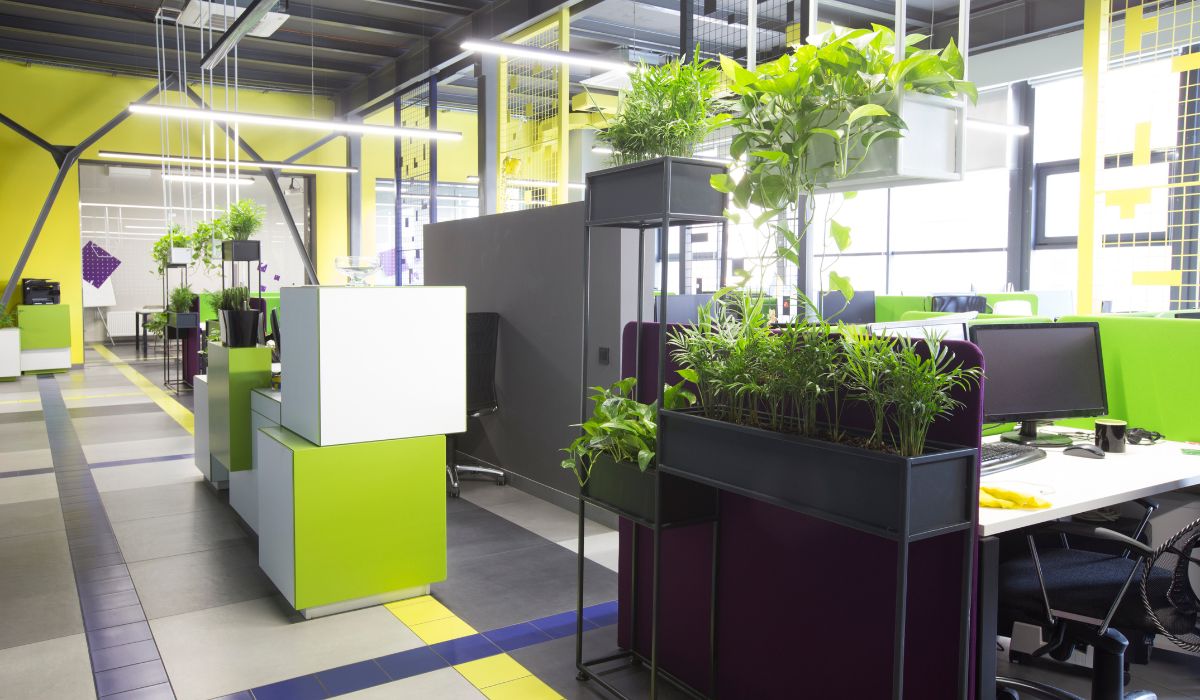
ABW organizes spaces around activities, while hot-desking focuses on using unassigned desks. In a hot-desking model, employees use available desks under the business’s shared seating rules instead of having a permanently assigned place.
Hot-desking can be used in an ABW office to manage shared seating. However, a business can use hot-desking without providing focus areas, collaboration zones, or private discussion spaces. In that case, the business changes how desks are used but does not organize the office around different activities as ABW does.
4.2. ABW and hybrid working
Hybrid working combines time in the office with time spent working elsewhere. Businesses set attendance schedules, coordination practices, and working arrangements based on the needs of each role.
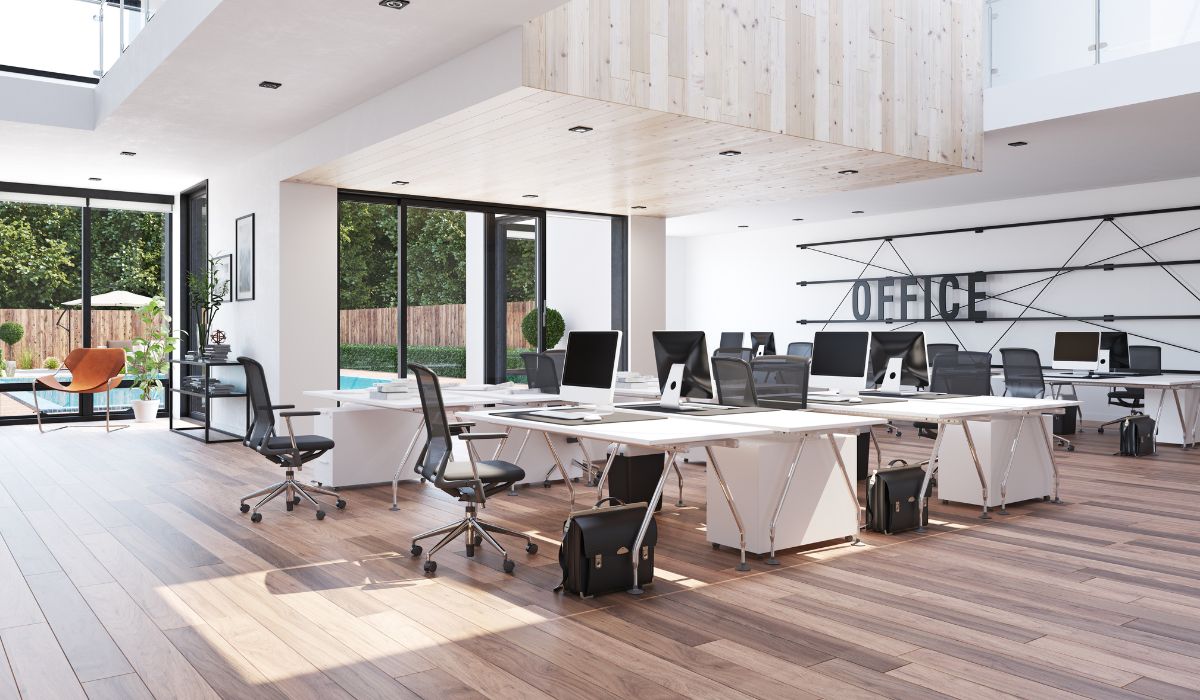
ABW focuses on how employees use the office when they are on-site. The two models can be combined when a business wants to plan seating around attendance levels and work activities. A business using hybrid working can still maintain assigned desks if that arrangement suits the work and operating conditions.
4.3. ABW, agile working, and flexible offices
Agile working emphasizes flexibility in how work is organized, employee autonomy, and collaboration across teams. ABW can support this approach by providing spaces for both individual work and team discussions.
A flexible office focuses on the ability to adjust layouts and how spaces are used. A business can use mobile desks, flexible partitions, or multipurpose rooms without adopting ABW. Agile working focuses on how people work, a flexible office on how spaces can change, and ABW on organizing spaces around activities.
4.4. ABW and open-plan offices
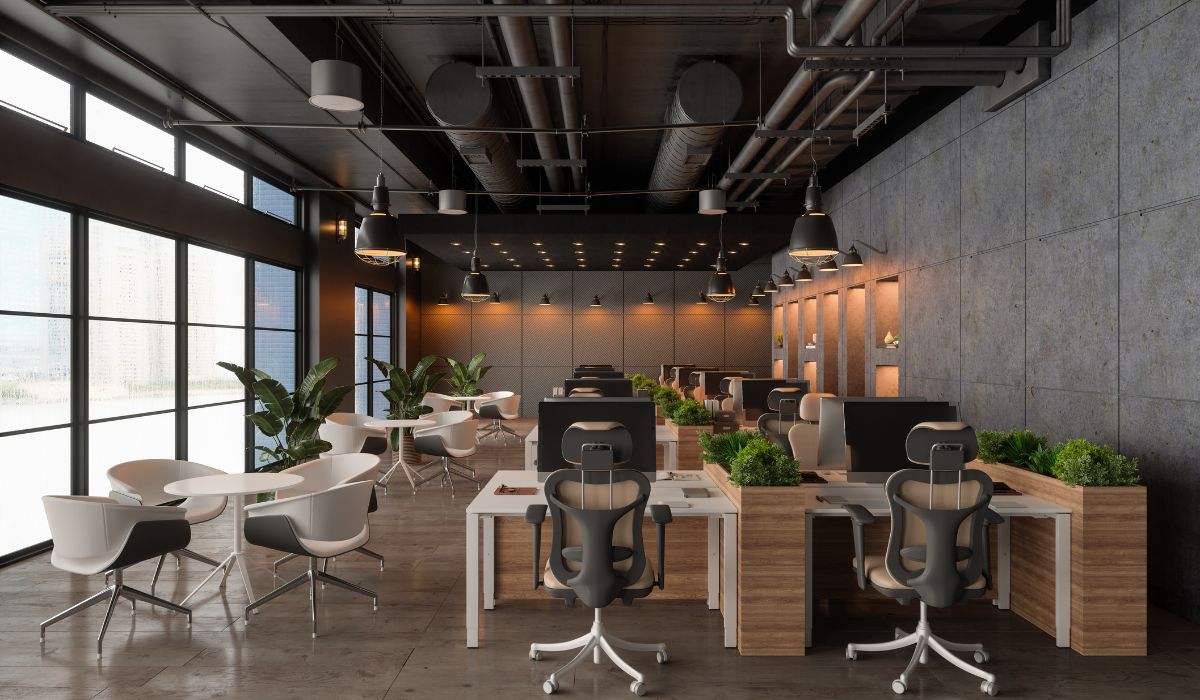
In an open-plan office, workstations are usually arranged in a space with few fixed partitions. This layout can make face-to-face conversations easier, but it may also create noise, interruptions, and a lack of privacy.
ABW can combine open work areas with small meeting rooms, phone booths, and separate focus spaces. Employees choose where to work based on their tasks instead of using one desk for every activity. Quiet and privacy levels depend on the layout, acoustic conditions, and how the spaces are used in practice.
5. Benefits and limitations of ABW
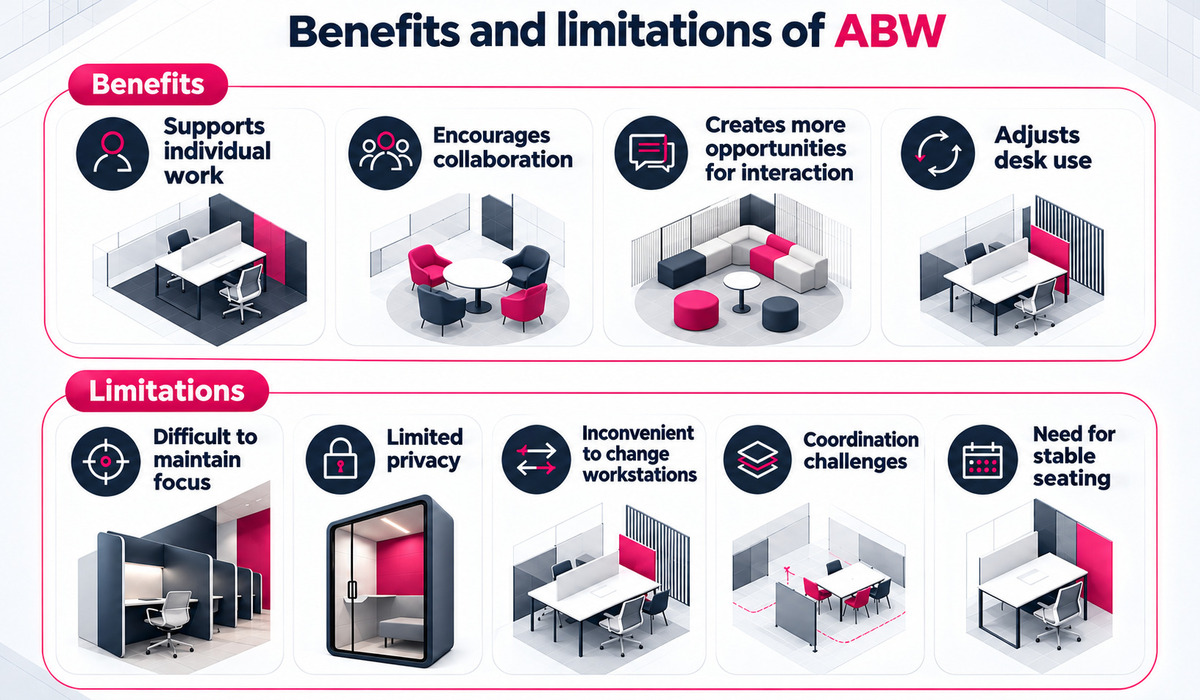
ABW can improve how a business uses space and supports collaboration, while creating challenges around focus, privacy, and operations. Results depend on the nature of the work, how teams are organized, and each business’s implementation conditions.
5.1. Benefits of Activity-Based Working
When spaces suit employees’ work needs, ABW can support a range of activities and give businesses more flexibility in how they use desks. Potential benefits include:
- Supports individual work: Quiet spaces meet the need for focus and help reduce interruptions.
- Encourages collaboration: Team areas make it easier for employees to discuss and coordinate work in person.
- Creates more opportunities for interaction: Shared spaces can increase contact between colleagues, but do not guarantee better collaboration.
- Adjusts desk use: Businesses with uneven attendance can use shared desks instead of maintaining a permanently assigned desk for every employee.
5.2. Limitations of Activity-Based Working
Activity-Based Working also requires careful consideration of focus, privacy, and coordination when employees use different workstations. If the spaces or operating arrangements do not meet actual needs, the following issues may arise:
- Maintaining focus can be difficult: A shortage of quiet spaces or poor noise control can disrupt work.
- Privacy may be limited: Shared spaces may not suit confidential discussions or the handling of sensitive documents.
- Moving between workstations can be inconvenient: Employees who need many documents or specialized equipment may find frequent moves difficult.
- Coordination can become more difficult: Employees using unassigned desks need to find a suitable seat and locate colleagues when they need to talk.
- Some employees need stable seating: Certain roles still require an assigned desk because of the nature of the work or specific operating conditions.
6. When is ABW suitable for a business?
ABW may be worth considering when employees regularly switch between focused work, discussions, and team meetings. Before choosing the model, a business should assess the nature of the work, seating needs, and its ability to manage daily operations.
6.1. Needs for focus, discussion, and information security
Teams that regularly move between individual work, group meetings, and online discussions may benefit from activity-based spaces. Businesses should provide quiet areas for focused work and suitable spaces for discussions.
Employees handling sensitive information or using specialized equipment may need a stable workstation and dedicated conditions. Businesses should identify which tasks suit shared desks and which require a separately assigned workspace.
6.2. Attendance levels and seating needs
The number of employees present in the office helps a business assess whether shared desks are suitable. When on-site attendance is consistently lower than total headcount, some employees may share desks. The business should still check peak attendance periods to determine how many people may need a seat at the same time.
The number of seats must accommodate periods when many employees are in the office. Reducing the number of assigned desks does not necessarily reduce the required office area, since the business still needs meeting rooms, support spaces, and circulation routes. These elements should be considered together in the floor plan.
6.3. Employee readiness and operating conditions
Employees need to understand the purpose of each space, how to use meeting rooms, and how to coordinate when they do not have assigned desks. Businesses should establish a system for managing shared seating so employees use spaces appropriately and can contact colleagues when needed.
Before making the change, businesses should consult employees and managers to identify potential challenges. The network, document storage, and work equipment should also support movement between workstations. If the operating requirements are not fully in place, a business can start by introducing ABW to selected teams.
7. Steps for preparing and implementing ABW in an office
Businesses can implement ABW through a series of steps, from assessing needs to making adjustments after the office is in use. The sequence and scope depend on the project size, existing floor plan, and how significantly office use will change.
7.1. Assess existing conditions and work needs
Businesses should assess the existing floor plan and how employees use the office, while gathering feedback from employees and managers. The assessment should cover:
- Existing floor plan: Record usable area, workstation locations, meeting rooms, circulation routes, partitions, and technical infrastructure.
- Usage patterns: Check desk and meeting room utilization, discussion needs, noise levels, and privacy.
- Work needs: Identify tasks requiring focus, calls, teamwork, and coordination across departments.
The assessment helps businesses identify demand for each type of space. However, this information alone is not enough to determine how much floor area to allocate. Businesses should check the allocation ratios when developing the floor plan.
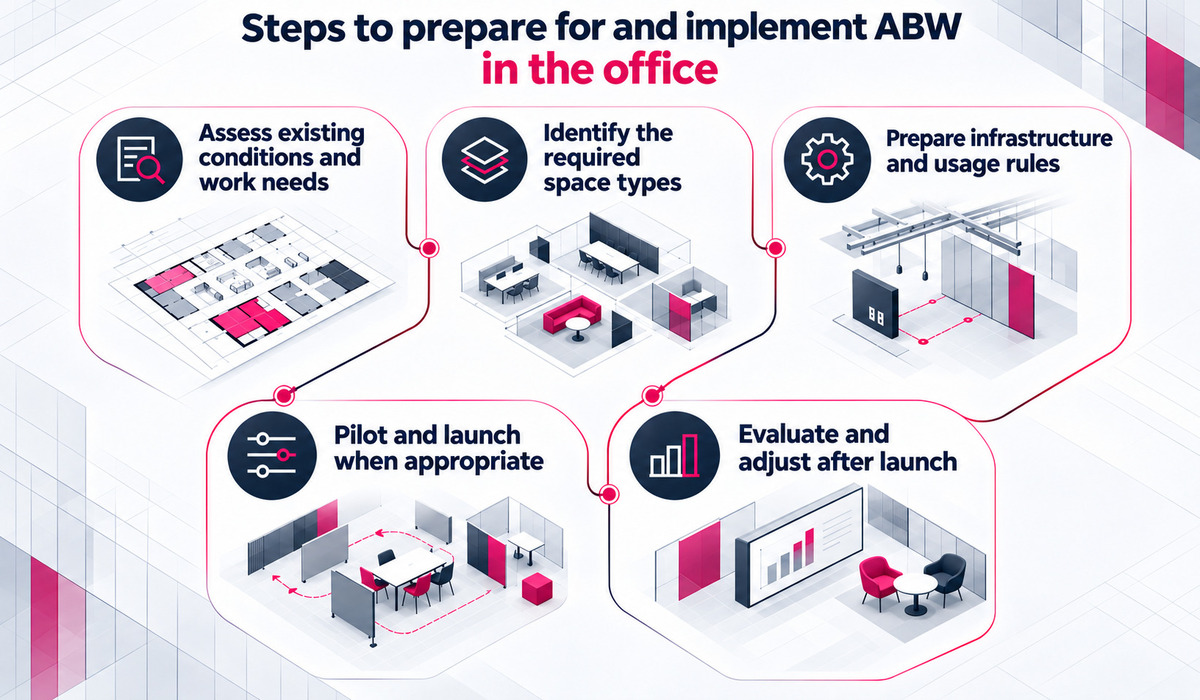
7.2. Identify the types of spaces required
Based on the assessment, businesses should identify the spaces they need and how these spaces relate to one another. Focus areas should be separated from places where discussions happen frequently. Meeting rooms and collaboration spaces should be convenient for teams that work together often.
The plan should account for usable area, electrical and network systems, air conditioning, lighting, and the building’s technical requirements. Flexible furniture or suitable partitions can support changes in how spaces are used. The space schedule provides a basis for planning the office layout, with the number of desks, meeting rooms, and area allocation checked for each project.
7.3. Prepare infrastructure and usage rules
Before introducing ABW, businesses should prepare workstations for use across multiple locations and agree on rules for using each space. Key preparations include:
- Work infrastructure: Check network access, power supply, online meeting equipment, noise control, and storage for personal belongings.
- Management tools: Consider booking software, space maps, or sensors based on usage needs and scale.
- Usage rules: Agree on how to use meeting rooms, shared desks, quiet areas, and clean up after work.

These conditions should support employees working from different locations. Agreed rules can guide employees during the transition. If data collection technology can identify employees, businesses should review data processing practices under the Law on Personal Data Protection and relevant regulations.
7.4. Pilot and launch when appropriate
If a business wants to gather feedback before expanding, it can pilot ABW within a limited area. The pilot can focus on how employees choose seats, use functional rooms, and coordinate with one another. Issues such as insufficient seating, noise, or difficulty using equipment should be recorded so the plan can be adjusted.
When ABW is introduced, businesses should explain the purpose of each space and provide a point of contact for support. A feedback channel can help address operational inconveniences. The pilot’s scope and duration depend on project conditions. For minor changes with sufficient preparation data, a business can proceed without setting up a separate pilot area.
7.5. Evaluate and adjust after launch
After implementing ABW, businesses should monitor how each type of space is used and collect employee feedback. Areas to review include seating shortages, meeting room utilization, noise in focus areas, and whether employees can find suitable spaces.
The evaluation may lead to changes in the number of shared desks, additional private spaces, or revised usage rules. The timing depends on the operating plan and the extent of the changes. Businesses should compare usage data with employee feedback before deciding what to adjust.
ABW should be considered in light of work needs and the office’s ability to meet them. Once the required spaces and operating conditions have been identified, businesses can incorporate them into an office interior design plan and choose an implementation scope suited to the existing floor plan.
8. Frequently asked questions (FAQ) about Activity-Based Working (ABW)
8.1. Should small businesses adopt ABW?
Yes. Small businesses can adopt ABW without providing every type of space. With limited floor area, they should prioritize frequent activities and identify spaces that can serve multiple purposes. If the work requires many stable workstations or private rooms, the business should adjust the scope to suit its needs.
8.2. Can ABW reduce office rental and operating costs?
ABW may reduce the number of assigned desks that are rarely used, but rental and operating costs do not automatically decrease. Rental costs depend on the area leased and the terms of the lease. When comparing options, businesses should also account for renovation, functional rooms, equipment, and operating management.
8.3. How can employees adapt to flexible seating?
Employees need to understand the reasons for the change, receive guidance on using the spaces, and have a channel for providing feedback during operations. Businesses should record any inconveniences and adjust how spaces are used. Roles requiring permanently available equipment or the handling of specialized documents may continue to use assigned desks.
8.4. Is booking software or sensors required to adopt ABW?
No. An office with a small number of shared seats can manage them with usage rules or a simple booking method. When booking needs and usage tracking become more complex, businesses can use software or sensors. If a tool can identify employees while collecting data, the business should comply with relevant personal data protection regulations.
8.5. Can ABW be introduced in stages instead of renovating the entire office?
Yes. A business can keep some assigned desks while adding focus or collaboration spaces as needed. A partial implementation can be maintained long term; it does not have to be a pilot before a wider rollout. The scope depends on employees’ work and the conditions of the floor plan.