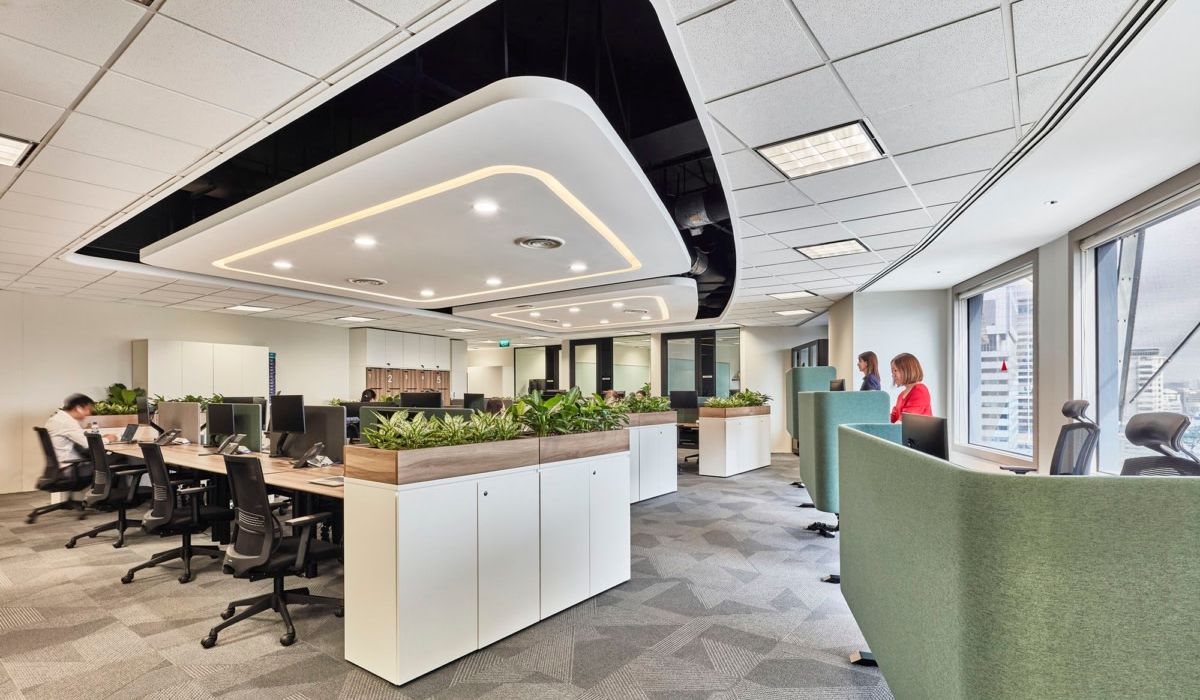
Before choosing an office interior design partner, businesses should assess project experience, consulting capabilities, and scope of work. A company portfolio and completed deliverables help verify whether a firm is a good fit. If the contract covers both design and construction, businesses should also assess the contractor’s construction capabilities.
1. Assess the office interior design firm’s capabilities
A design firm’s capabilities should meet the office’s functional requirements, site conditions, and technical constraints. Businesses can assess its suitability by reviewing its project experience, assigned team, and design documentation.
1.1. Similar projects and completed scope
Experience is valuable when a firm has delivered projects with similar sizes, site conditions, and operational requirements. Experience in the same industry can provide additional context, but suitability also depends on the specific work the firm handled directly.
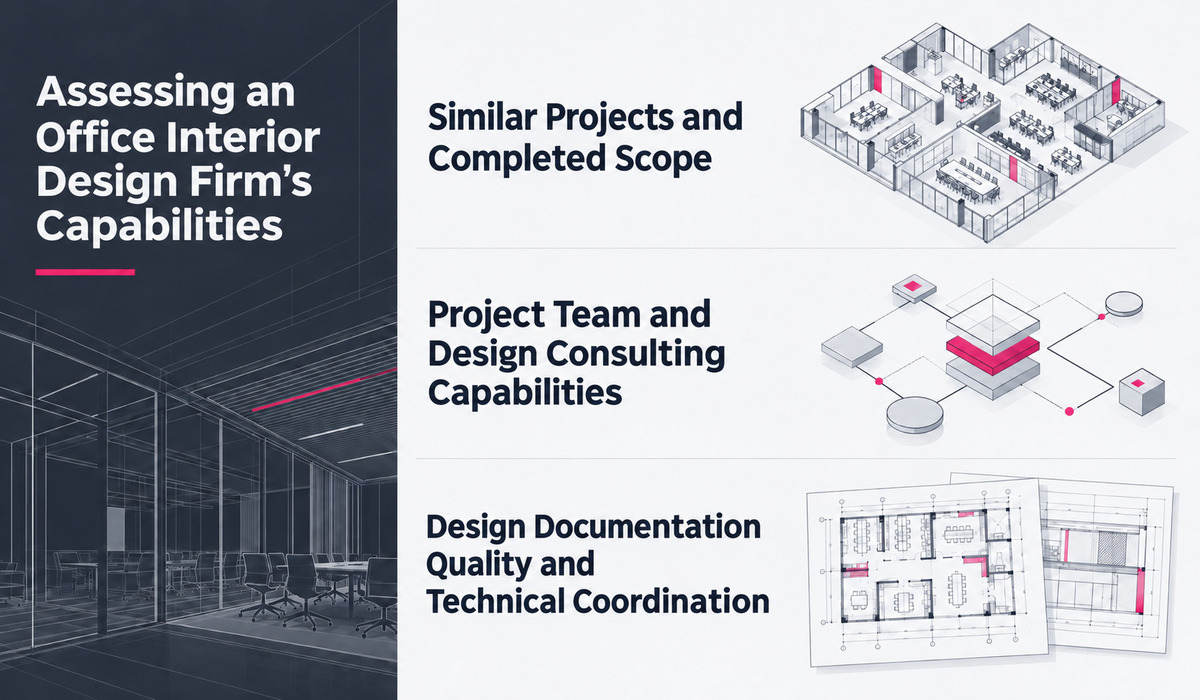
When reviewing a company portfolio, businesses should check three areas:
- Project similarity: Size, site conditions, and operational requirements.
- Completed scope: The design work the firm handled directly.
- Evidence: Project records, drawings, images, and completed deliverables that the firm is authorized to share.
1.2. Project team and design consulting capabilities
A firm’s consulting capabilities are reflected in how it gathers requirements, assesses existing conditions, and explains design proposals. The project team should account for staffing levels, departmental activities, meeting and storage needs, and growth plans. This input helps the firm propose a suitable office layout.
Businesses should identify the design lead, the person who will receive feedback, and the person who will review the documentation before handover. When reviewing a proposal, they should assess how it addresses lighting, acoustics, layout flexibility, and technical requirements. Design trends should be applied in response to functional needs and site conditions.

1.3. Design documentation and technical coordination
Businesses can assess design documentation by checking whether the drawings are clear and consistent. Sample documentation, where sharing is permitted, should match the service scope and may include floor plans, renderings, interior details, or material specifications. Dimensions, locations, and finish requirements should be consistent to support technical coordination.
If the design involves electrical, lighting, air conditioning, ventilation, or fire protection systems, businesses should clarify who is responsible for each discipline. The parties should agree on how to resolve conflicts between the interior layout and building systems. For a standalone design contract, production and construction capabilities are relevant when the firm accepts related responsibilities.
2. Compare proposals and fees from design firms
To compare design firms, businesses should identify the equivalent work included in each proposal. Fees, schedules, and deliverable lists may differ because of design requirements or each firm’s scope of responsibility.
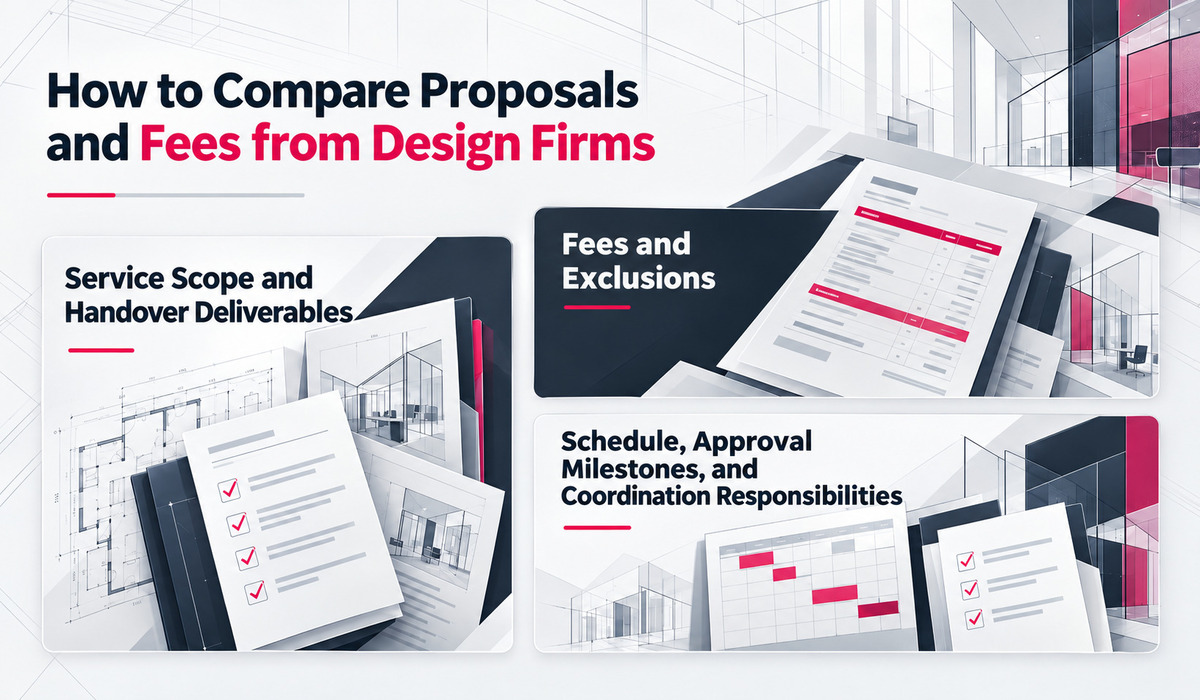
2.1. Service scope and deliverables
A design proposal should clearly define the firm’s scope of work and the corresponding deliverables. Businesses should check three areas:
- Design work: Existing condition surveys, layout planning, 3D renderings, material selection, and technical documentation.
- Deliverables: Documents, drawings, and materials for each work item, so the parties can review and approve them.
- Handover conditions: File formats, number of revisions, and any technical support responsibilities.
Article 8 of Circular No. 03/2020/TT-BXD sets out the drawing and explanatory components of interior design documentation. Where the circular applies, the documentation is prepared according to the requirements agreed between the project owner and the design contractor. The specific deliverables should be agreed in the contract.
2.2. Design fees and exclusions
Design fees should be compared based on the service scope, level of detail, and working conditions. Firms may quote different amounts because of the number of design options, revision rounds, survey requirements, or technical coordination responsibilities. Businesses should clarify how fees are calculated and when payments are due.
The quotation should specify exclusions, conditions that may incur additional fees, and how changes are approved. Businesses should check whether value-added tax, travel costs, and fees for out-of-scope revisions are included. For a combined design and construction contract, construction costs should be assessed separately based on quantities, materials, and technical requirements.

2.3. Schedule, approval milestones, and coordination responsibilities
The design schedule should show each project phase, its deliverables, and when the business must approve them. The timeline depends on site complexity, how quickly information is prepared, the number of revisions, and technical coordination requirements. Before accepting the proposed timeline, businesses should check what could affect it.
The business is responsible for confirming requirements and providing feedback on proposals according to the agreed schedule. The design firm performs the work covered by the contract and coordinates with relevant parties. If the schedule depends on documents from the building management team or technical contractors, the plan should specify when those documents will be provided and received, and how delays may affect the schedule.
3. Check legal standing and post-handover responsibilities
Before selecting a design firm, businesses should check its legal standing and post-handover responsibilities. The checks depend on the service scope, type of work, and project requirements.
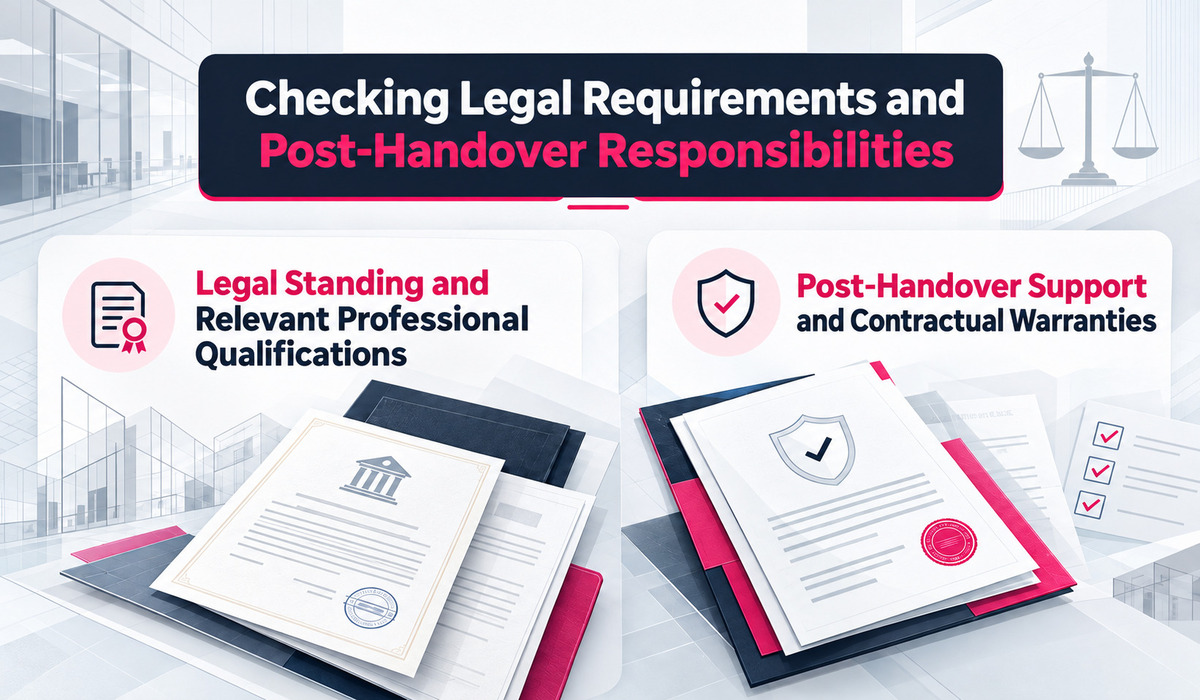
3.1. Legal standing and relevant professional qualifications
Legal requirements should be checked against the work the firm will perform. Businesses should review the following:
- Legal standing: Company details, signatory, authority to sign the contract, and the services the firm agrees to provide.
- Professional qualifications: The qualifications or certificates of the responsible individuals, where required by law.
- Building systems and fire protection: Documentation and procedures required when work affects building systems or is subject to fire safety management.
- Insurance, safety, and acceptance: Requirements based on the type of work, applicable regulations, and contractual responsibilities.
Requirements for lead designers, technical consultants, and construction contractors may differ. Approval from building management should be distinguished from procedures that fall under the authority of government agencies.
3.2. Post-handover support and warranties under the contract
For design services, the contract should clarify the support available after the design documentation is handed over. The design firm may explain the drawings, address discrepancies that fall within its design responsibilities, and clarify information during construction. The parties should also agree on the support period and conditions.

If the firm also supplies products or carries out interior construction, warranties should be specified for each item. Businesses should check the warranty period, covered cases, point of contact, and process for handling issues. Construction warranties, equipment warranties, and support for design documentation have different scopes and should be assessed separately.
4. Questions to ask an office interior design firm
When speaking with a design firm, businesses should clarify its capabilities, service scope, and working arrangements. Key information should be checked against the company portfolio, design proposal, and related documents.
- Which office projects has the firm completed with similar sizes and requirements? What work did it handle directly?
- Who will lead the design, manage communication, and respond to feedback?
- How will the firm gather, assess, and confirm the business’s design requirements?
- How does the firm plan to address site limitations and the building’s technical requirements?
- What design work and documentation are included in the service scope?
- What costs are included in the quotation? Which work and fees are excluded?
- What approval milestones are included in the design schedule? How will the firm handle design revisions?
- How will responsibilities be divided when coordinating with technical contractors or construction firms?
- What support will the firm provide after handing over the design documentation, as specified in the contract?

Businesses should record answers and related documents for review and comparison. When consulting multiple firms, using the same questions helps compare their capabilities, scope, and working arrangements on a consistent basis.
5. Suggested scoring table for selecting an office interior design firm
Businesses can rate each criterion from 1 to 5 based on how well it meets requirements and how much information has been verified. The table can be used for an initial comparison of two firms against the same criteria.
| Evaluation criterion | Information to compare | Firm A (1–5) | Firm B (1–5) |
|---|---|---|---|
| Experience with similar projects | Project records and completed scope | ||
| Team and consulting capabilities | Project lead and approach to receiving and addressing requirements | ||
| Quality of design documentation | Sample documents, level of detail, and technical coordination capabilities | ||
| Service scope and deliverables | Work list, deliverables, and exclusions | ||
| Design fees and quotation terms | Fee calculation, payment terms, and change management | ||
| Schedule and coordination responsibilities | Plan, approval milestones, and allocation of responsibilities | ||
| Post-handover support | Support and commitments under the contract | ||
| Maximum total score | 7 criteria × 5 points | /35 | /35 |
A score of 1 indicates a low level of fulfillment, 3 indicates basic fulfillment, and 5 indicates strong fulfillment supported by clear evidence. Scores of 2 and 4 represent intermediate levels. If information is insufficient, businesses should record “Pending verification” rather than assign a score of 0. Calculate the total once all seven criteria have been assessed.

The seven criteria carry equal maximum scores for an initial comparison. Businesses should separately check mandatory professional qualifications and project requirements. A high total score does not replace the need to meet essential conditions identified before selection.
6. Considerations when selecting an office interior design firm
After scoring the firms, businesses should review any remaining differences that could affect the decision. A company portfolio and total score support an initial comparison. The final decision also depends on project requirements and verified commitments.
6.1. Assess overall suitability, not just the total score
The total score shows how well each firm meets the selected criteria, but it does not fully reflect the importance of each requirement. For an office renovation while the business remains operational, the ability to conduct surveys and coordinate technical work may be a priority. For a standalone design contract, consulting capabilities and documentation quality may carry more weight.
Before selecting a firm, businesses should define mandatory requirements and the criteria that can be treated flexibly. Scores should be checked against evidence of capability, contract terms, and any unresolved issues.
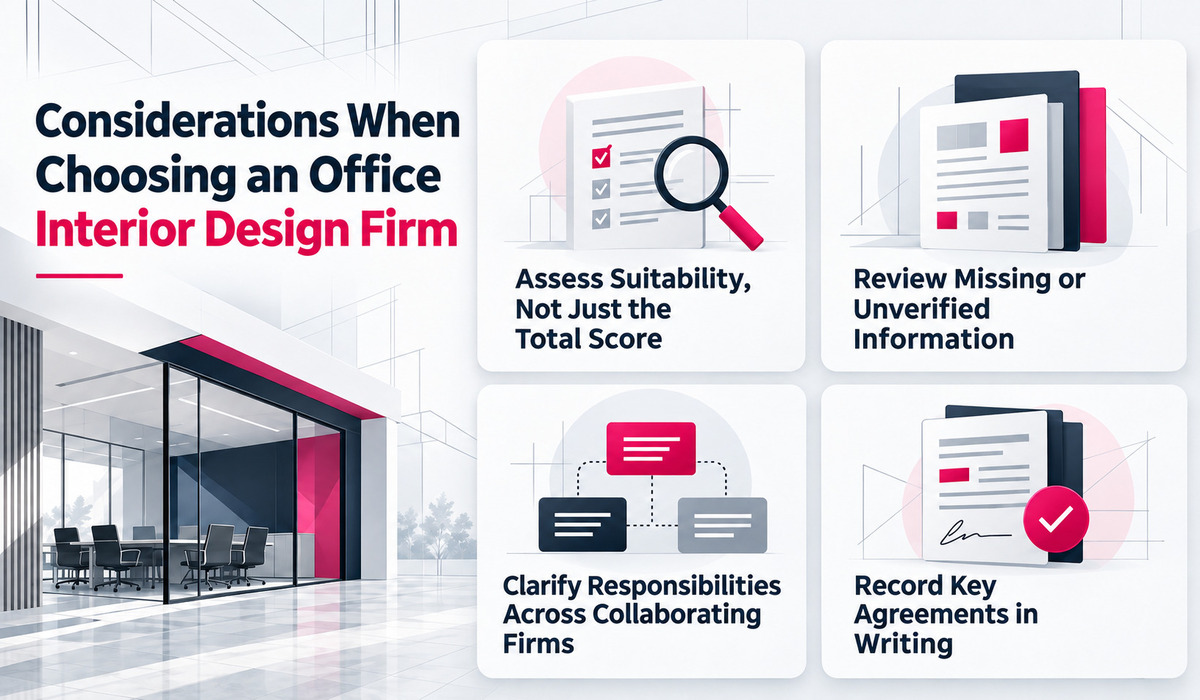
6.2. Verify missing or unconfirmed information
Company portfolios and quotations may describe the work only in general terms. Businesses should verify the firm’s actual role in past projects, the proposed project team, and which work items are included in the quotation. Information without supporting documents should be recorded separately for follow-up.
If the initial discussions differ from the written proposal, the parties should confirm the details before making a selection. Unresolved differences in scope, schedule, or responsibilities can lead to different interpretations during the contract.
6.3. Clarify work shared among collaborating firms
An office design project may require technical consultants, suppliers, or construction firms. The coordination approach depends on the service scope and existing site conditions. Businesses should identify the work performed directly by the design firm, the work handled by its partners, and who is responsible for reviewing the results.

When multiple parties revise documents or address technical requirements, their responsibilities should be agreed. Businesses should also designate a main contact to prevent gaps in information or inconsistent responses.
6.4. Record important agreements in writing
Important agreements should be documented in the proposal or contract, depending on when the parties confirm them. Businesses should compare the following:
- Scope and handover: Agreed work and deliverables.
- Fees and schedule: Fees, timeline, and project milestones.
- Team and coordination: Project lead and coordination responsibilities among the parties.
- Revisions and additional work: Conditions for design revisions, additional work, and approval.
Before signing the contract and starting work, businesses should compare the final proposal or contract with the information used to assess the design firm. If an important commitment has not been documented, the parties should add it or confirm it in writing.

Businesses should choose an office interior design firm based on its demonstrated capabilities, suitability for the project requirements, and confirmed working arrangements. Before signing, they should compare the company portfolio, scope of work, and key commitments to clarify responsibilities and reduce the risk of additional work during delivery.
7. Frequently asked questions about choosing an office design firm (FAQ)
7.1. Should businesses prioritize firms with their own production facilities?
A firm’s production facilities are worth considering when the contract includes supplying or constructing interior elements. For a standalone design service, businesses should focus on consulting capabilities, documentation quality, and coordination responsibilities. Owning a production facility does not by itself guarantee design quality or timely delivery.
7.2. When should a business choose a turnkey design and construction service?
Businesses may consider a turnkey design and construction service when they want a single point of contact to coordinate all project phases. Suitability also depends on the project scope, budget, and internal management resources. Before selecting a firm, businesses should check its design and construction capabilities and the responsibilities specified in the contract.
7.3. Should a business choose a firm that has designed offices in the same industry?
Experience in the same industry can help a firm identify specific operational requirements, but it is not mandatory. Projects in other industries can still be relevant if they are similar in size, function, and technical conditions. Businesses should check what work the firm handled and whether it can address comparable requirements.
7.4. Should a business hire a design firm based in a different location from its office?
A business can hire a firm based elsewhere if its site surveys and coordination meet the project requirements. Before entering into an agreement, the business should confirm the schedule for in-person surveys, the assigned team, and travel costs. It should also clarify how the firm will coordinate with local building management and technical contractors.
7.5. Should businesses request a trial design proposal before signing a contract?
Businesses can ask the firm to explain how it would address the requirements or present a preliminary proposal to assess its capabilities. Before the work begins, the parties should agree on the level of detail, any fees, and the rights to use the materials. A trial design proposal depends on mutual agreement; it is not an automatic obligation of the design firm.